Insights
SEO for Plumbers: What Actually Ranks in 100 Cities
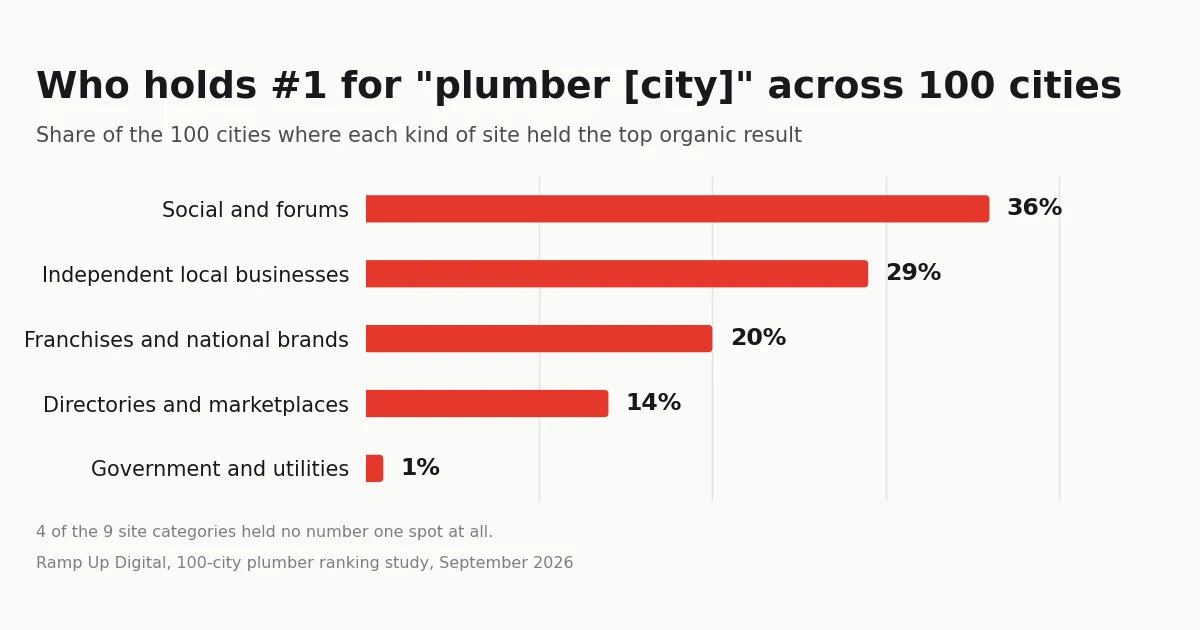
We parsed 880 ranking slots across 100 cities to see what really ranks for plumber searches. The page type, the template, the conversion layer, the gaps.
Sep 26, 2026|17 min read
Every Google Maps ranking guide gives you the same checklist. Here's the strategic framework that actually determines who wins the local pack, and how to beat your #1 competitor.

There are hundreds of guides on how to rank in Google Maps. They all say the same things: optimize your GBP, get reviews, build citations. They are all correct. And they are all incomplete. Here is what they miss.
The businesses that dominate the local pack are not just following checklists. They are making strategic decisions about where to invest their limited time and budget based on their specific competitive landscape. A checklist tells you what to do. A strategy tells you what to do first, what to do most, and what to skip entirely.
This guide gives you the strategy.
Every Google Maps guide starts here: relevance, distance, and prominence. But most guides treat these three factors as equally important. They are not. The weighting shifts dramatically depending on the type of query.
For competitive, high-volume queries like "plumber near me" or "best restaurant in San Mateo": prominence dominates. Google has dozens of relevant businesses at roughly equal distances. The tiebreaker is authority: review count, review quality, citation strength, website authority, and content depth. If you are competing for these queries, your strategy should be heavily weighted toward building prominence.
For hyper-local queries like "coffee shop in downtown San Carlos": distance dominates. Google prioritizes businesses physically closest to the specified location. You cannot change your address, which means if you are not physically located in the target area, no amount of optimization will overcome the distance factor for these queries.
For niche service queries like "emergency root canal dentist" or "commercial HVAC repair": relevance wins. There are fewer businesses that match the specific service, so Google weights category accuracy, service listings, and content relevance more heavily. If you serve a niche, doubling down on relevance signals is your highest-leverage move.
The strategic takeaway: Before you optimize anything, ask yourself what type of queries you are trying to win. That determines where your effort should go. A restaurant competing for "best Thai food in Redwood City" has a completely different optimization priority than a specialized medical practice trying to rank for a niche procedure.
Stop guessing why your competitor ranks above you. Diagnose it systematically. Here is the framework we use with every client.
Pull up the Google Maps results for your most important keyword. Look at the business that holds the #1 position. Now compare these factors between their listing and yours:
The gap between you and #1 tells you exactly what to fix. If they have 300 reviews and you have 40, your priority is review generation, not citation building. If your review counts are similar but their website has 30 service pages and yours has 5, your priority is content. Do not spread your effort across everything equally. Attack the biggest gap first.
Strategic sequencing matters. Here is how to spend your first 30 days if you are serious about improving your Google Maps ranking.
This is where you fix the basics that are silently holding you back:
NAP consistency is the most common issue we find in local SEO audits, and it is one of the fastest to fix:
Launch a systematic review generation process:
Your website and your GBP work together. A weak website limits how high your profile can rank:
There is a persistent myth in local SEO that you need to be listed on hundreds of directories. You do not. What you need is perfect consistency across the directories that actually matter.
Here are the directories that move the needle, in order of importance:
How to audit your citations: Use BrightLocal, Whitespark, or Moz Local to scan for inconsistencies. Run the scan quarterly. Every time you change your phone number, move offices, or update your business name, re-audit immediately.
Being on 500 directories with inconsistent information is worse than being on 20 with perfect accuracy. Quality and consistency beat quantity every time.
Asking for reviews is not a strategy. Building a review generation system is. The distinction matters because systems produce consistent results regardless of whether any individual person remembers to ask on any given day. We break down exactly how to build one in our full guide on how to get more Google reviews.
Volume matters, but velocity matters more. Google's algorithm weights recent reviews more heavily than old ones. A business that received 50 reviews in the last 90 days will outrank a business with 500 total reviews but only 5 in the last quarter. Your review strategy needs to produce a steady, ongoing flow, not occasional bursts.
Here is the system that works:
What not to do: Never buy reviews. Never offer discounts or incentives for reviews. Never use review gating (filtering out negative reviews before they reach Google). All of these violate Google's guidelines and can result in review removal, profile suspension, or permanent ranking penalties.
This is the ranking factor most local businesses are not paying attention to yet, and it is reshaping local search in real time.
A growing share of local queries now trigger AI Overviews that can summarize results and sometimes bypass the traditional map pack entirely. When someone searches "best electrician in San Mateo County," Google's AI may generate a curated answer that highlights specific businesses, pulling from reviews, website content, and structured data, before the user ever scrolls to the map pack.
This means you can rank well in the traditional map pack and still lose visibility to AI-generated results. Or, more optimistically, you can use AI Overviews to leapfrog competitors who are only optimizing for the map pack.
To position yourself for AI Overviews:
The businesses that optimize for both the map pack and AI Overviews now will have a significant advantage as Google continues shifting toward AI-first search results.
Checklists get you into the game. A moat keeps you winning. The strategies below compound over time and are genuinely difficult for competitors to replicate, which is exactly why they work.
Location-specific content. Do not just create a single location page. Build content that demonstrates genuine expertise in your service area. Write about local events you sponsor, local projects you have completed, challenges specific to your area (weather, regulations, demographics). A plumber who publishes "Why San Mateo County Homes Built Before 1970 Need Pipe Inspections" demonstrates local expertise that no national competitor can match. Movers who serve dozens of towns face the hardest version of this, and our guide to SEO for moving companies shows how to cover a whole region with a few strong pages instead of many thin ones.
Local link building. Links from local organizations carry disproportionate weight for local search rankings. Sponsor a little league team, a school event, a community festival, or a local nonprofit. These sponsorships almost always include a website link, and that link is both a ranking signal and a trust signal.
Local PR and media coverage. Getting mentioned in local news outlets, community blogs, or neighborhood newsletters builds prominence signals that are extremely hard for competitors to replicate. Offer expertise for local news stories. Write guest columns for community publications. Be the go-to source when a reporter needs a quote from a local business owner.
Community involvement that generates content. When you sponsor an event, photograph it and write about it on your website. When you volunteer, share the story. This creates a virtuous cycle: your community involvement builds links, generates content, earns reviews from grateful community members, and strengthens your reputation, all of which feed back into your Google Maps ranking.
None of this is fast. But it is the difference between a business that ranks well today and a business that dominates local search for years. Checklists can be copied overnight. A genuine local presence cannot.
For businesses serving the San Mateo County area, check out how our local SEO services help build this kind of long-term competitive advantage. And if you are in the restaurant industry, our guide on local SEO for restaurants covers industry-specific tactics that complement everything in this guide.
Every business in your market has access to the same Google Maps optimization checklists you do. The businesses that win are the ones that go beyond the checklist, that understand their competitive gaps, prioritize ruthlessly, and build compounding advantages their competitors cannot easily replicate.
Want a strategic Google Maps ranking plan built for your specific competitive landscape? Contact Ramp Up Digital for a free local SEO assessment. We will show you exactly why your #1 competitor outranks you and what it will take to pass them.
Keep Reading

