Insights
SEO for Plumbers: What Actually Ranks in 100 Cities
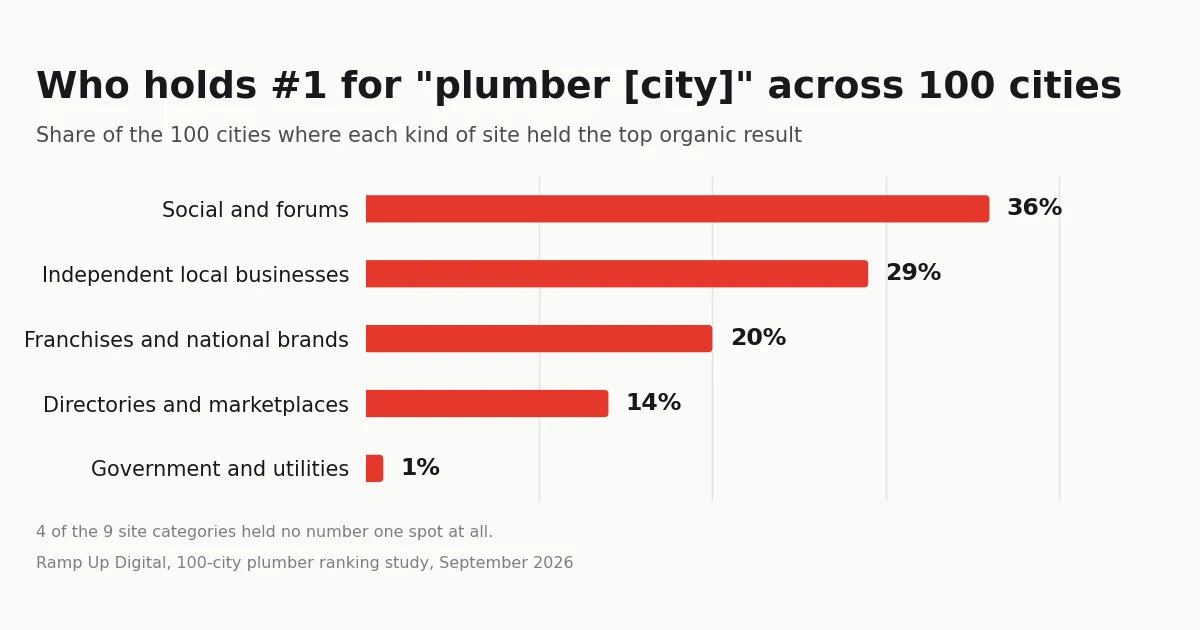
We parsed 880 ranking slots across 100 cities to see what really ranks for plumber searches. The page type, the template, the conversion layer, the gaps.
Sep 26, 2026|17 min read
SEO, Google Ads, or LSAs: which drives the most plumbing leads? A data-driven comparison from an agency managing all three for Bay Area plumbing companies.

Every plumber wants more leads. The question is not whether to invest in marketing -- it is which channels actually deliver and which ones drain your budget with nothing to show for it. We manage SEO, Google Ads, and Local Services Ads for multiple plumbing companies across the Bay Area. Here is what the data shows about where plumbing leads actually come from, what they cost, and how to build a marketing strategy that compounds over time.
The internet is full of advice about plumber marketing. Most of it is written by marketing platforms trying to sell you their software, or by agencies that manage restaurants and dentists and plumbers and law firms all with the same generic playbook. Plumbing has specific dynamics -- emergency versus scheduled demand, extreme seasonality, high customer lifetime value -- that require a specific approach.
There are only three channels that consistently generate qualified plumbing leads from Google. Everything else is either too expensive, too low-intent, or too unreliable to build a business around.
LSAs are the ads that appear at the very top of Google with the "Google Guaranteed" badge. You pay per lead, not per click. For plumbing, lead costs through LSAs typically run $25 to $50 per lead -- significantly cheaper than Google Ads on a per-lead basis.
The advantages:
The limitations:
Traditional Google Ads appear below LSAs but above organic results. You pay per click, and CPCs for plumbing keywords run $9 to $15 per click. Cost per lead averages $130 to $180 for well-managed plumbing accounts.
The advantages:
The limitations:
Organic search results appear below all ads. Ranking here means free, ongoing traffic -- but getting there requires sustained investment over months.
The advantages:
The limitations:
| Factor | LSAs | Google Ads | Organic SEO |
|---|---|---|---|
| Time to first lead | 1-2 weeks | 1-2 weeks | 4-8 months |
| Cost per lead | $25-50 | $130-180 | $30-60 (at maturity) |
| Control | Low | High | Medium |
| Scalability | Limited | High | Medium |
| Long-term ROI | Moderate | Moderate | Highest |
Based on managing all three channels for multiple plumbing companies, here is the approach we recommend -- and the approach we actually run for our clients.
Get your Local Services Ads running first. They are the fastest path to leads with the lowest risk because you pay per lead, not per click. Get your Google Guaranteed badge, set your service area and categories, and make sure you are responding to every lead within five minutes. Response time directly affects your LSA ranking.
Minimum investment: Your time to set up the profile plus the per-lead cost (typically $25 to $50 per lead for plumbing).
Once LSAs are running, add Google Ads for controlled growth. Start with your highest-intent service categories -- usually emergency plumbing and water heater services. Build dedicated landing pages for each campaign with click-to-call buttons, reviews, and service-specific content.
Why not start here? Google Ads require more setup, more ongoing management, and more budget to generate enough data for optimization. LSAs give you immediate lead flow while you build out your Google Ads infrastructure.
Start your SEO investment from day one, but understand that it is a long-term play. Build out service pages, optimize your Google Business Profile, start generating reviews, and create content that targets high-value keywords.
The compounding effect: By month 8 to 12, your organic SEO starts generating leads at $30 to $60 each. Your total cost per lead across all channels drops because you are blending expensive Google Ads leads with cheaper organic leads. By month 18 to 24, organic search often becomes your largest lead source by volume.
This is exactly what we run for our plumbing clients. The ones who commit to all three channels and give SEO time to mature end up with the lowest blended cost per lead and the most predictable lead flow. To understand whether this level of investment makes sense for your business, read our guide on whether SEO is worth it for small businesses.
Not every marketing channel deserves your money. Here is where we see plumbing companies waste budget most often -- and this is where our advice diverges from what most marketing blogs tell you.
Nobody searches Facebook when their pipe bursts. Social media advertising works for products people discover and desire -- fashion, food, gadgets. Plumbing is a need-based service with zero discovery component. You cannot create demand for a sewer line replacement with a clever Instagram ad.
The exception: retargeting campaigns that follow up with people who already visited your website can work on a very limited budget ($200 to $300/month). But as a primary lead generation channel, social media ads are a waste of money for plumbers.
Yelp's advertising model is expensive, and their organic algorithm actively depresses the visibility of businesses that do not advertise. We have seen plumbing clients pay $500 to $1,000/month on Yelp ads with cost-per-lead numbers that are 2 to 3x higher than Google Ads. Maintain a good Yelp profile with photos and responses to reviews, but do not rely on it as a lead source.
These can technically work, but you cannot track ROI with any precision. "How did you hear about us?" is not reliable tracking. When a plumber tells us they spend $2,000/month on mailers, our first question is: "How many booked jobs did those mailers produce last month?" The answer is almost always "I don't know." If you cannot measure it, you cannot optimize it, and you cannot justify the spend.
Shared leads are the fundamental problem here. When you buy a lead from Angi or HomeAdvisor, that same lead is simultaneously sent to three to five other plumbers. You are not buying a customer -- you are buying a chance to compete for a customer. Close rates on shared leads typically run 10 to 15%, compared to 25 to 35% for exclusive leads from your own Google Ads and SEO.
The math: a $30 Angi lead with a 10% close rate costs you $300 per booked customer. A $150 Google Ads lead with a 30% close rate costs you $500 per booked customer -- but that customer found YOU specifically, which typically means higher job values and better retention.
Similar to Angi in that you are competing on price with other plumbers for the same lead. Thumbtack customers tend to be more price-sensitive, which drives down average job value. It can fill slow weeks, but it should not be a cornerstone of your marketing strategy.
If you do not track your marketing, you are guessing. And guessing with $2,000 to $5,000/month in marketing spend is expensive guesswork.
Every plumbing company needs these three things at minimum:
Install call tracking on every marketing channel. Use a service like CallRail, CallTrackingMetrics, or WhatConverts. Each marketing channel -- Google Ads, LSAs, organic search, your website -- gets a unique tracking number. You know exactly which channel generated each call.
Cost: $45 to $100/month. The data it provides is worth 10x that.
Set up conversion tracking in Google Analytics for every form submission on your website. Tag each form submission with the source -- Google Ads, organic, direct, referral. This takes an hour to set up and provides permanent visibility into your non-phone lead sources.
You need to track what happens after the lead comes in. Did the call result in a booked job? What was the job value? Which service was it for?
At minimum, maintain a spreadsheet with columns for: date, lead source, service requested, booked (yes/no), job value. This is crude but effective. A CRM like ServiceTitan, Housecall Pro, or Jobber can automate this and tie it to your call tracking for a complete picture.
Know your cost per lead AND your cost per booked job. They are different numbers, and the difference matters. If your cost per lead is $150 but your close rate is only 20%, your cost per booked customer is $750. If a competitor's cost per lead is $200 but they close at 40%, their cost per customer is $500. The cheaper lead is not always the better investment.
This is the section most marketing guides skip because the math is not always flattering. Here it is honestly.
Average plumbing job values:
At $150 cost per lead and a 30% close rate, your cost per booked customer is $500.
For a $300 drain cleaning job, that is a 0.6x return. You are losing money acquiring that customer (unless they become a repeat customer, which many do). For a $3,000 water heater installation, that is a 6x return. For a $10,000 sewer line replacement, that is a 20x return.
The strategic implication is clear: focus your marketing budget on high-value services. This does not mean you never advertise drain cleaning -- those jobs build relationships that lead to bigger work. But your budget allocation should weight toward water heater, sewer line, and repipe campaigns where the revenue math works strongly in your favor.
One of our plumbing clients shifted 60% of their Google Ads budget from general plumbing and drain keywords to water heater and sewer campaigns. Their revenue from ads increased 40% while their ad spend stayed flat. Same budget, dramatically better results, because every lead was worth more.
For a framework on connecting marketing spend to revenue outcomes, our revenue-driven SEO guide covers this approach in depth.
If you are reading this and thinking "I do not have time to manage all of this myself," you are not wrong. Most plumbing business owners should not be managing Google Ads campaigns -- they should be running their business.
Here is what to look for in an agency and what to avoid:
You can learn more about how we approach digital marketing for Bay Area service businesses on our SEO agency page, or compare the economics of SEO and paid search in our SEO vs. PPC guide.
Plumber marketing does not need to be complicated. Run LSAs for immediate leads. Add Google Ads for controlled, scalable growth. Build SEO for long-term compounding returns. Track everything with call tracking and a CRM. Cut the channels that do not produce measurable results.
The plumbing companies that grow consistently are not the ones spending the most on marketing. They are the ones spending smartly -- on channels that produce measurable leads at a cost that makes financial sense, and cutting everything else.
Ready to build a lead generation strategy for your plumbing company? Contact Ramp Up Digital for a free assessment of your current marketing. We will show you which channels are producing, which ones are wasting money, and exactly what a data-driven plumber marketing plan looks like for your service area.
Keep Reading

