Most SEO guides for plumbers are written by companies that sell scheduling software. They are not wrong, exactly. They are just checklists, and nobody behind them has measured whether the items on the list are the things that separate a page at the top from a page on the second screen.
So we measured it. In September 2026 we searched "plumber [city]" in 100 cities, logged 880 ranking slots, and parsed 691 of the pages behind them. Everything below comes from the Ramp Up Digital plumber ranking factors study, and every number links back to it.
This covers both sides: who wins these results, and what the winning pages have on them. Which part you act on first depends on whether you run one truck in one city or eight trucks across a metro.
If you have paid an agency for a year and seen nothing move, the numbers here tell you where the money went, and if you are about to hire someone they are a list to grade the pitch against. If you handle this yourself between jobs, it is a build order for Sunday nights.
We grouped it into four parts: who owns these results, what the winning page looks like, how that page turns a visit into a booked job, and what to measure once it is live. Google Maps and the local pack are their own subject, and we cover those in our guide to local SEO for plumbers. Start with the part most owners get wrong: who you are actually competing with.
Who Owns the Plumber Searches in Your City
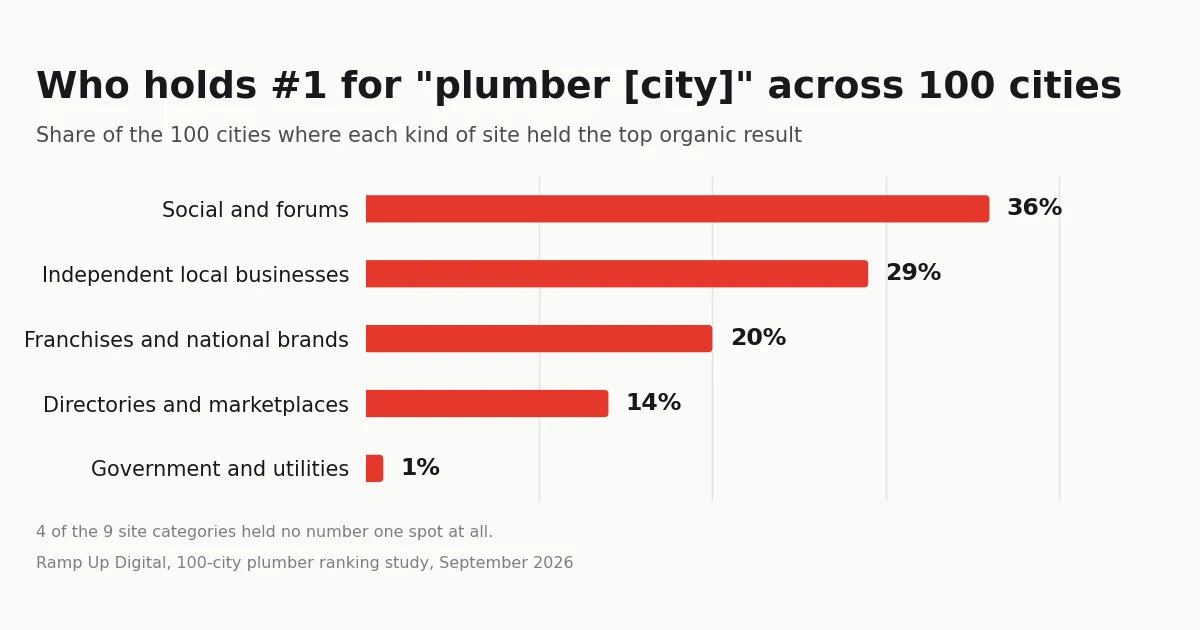
A local plumbing business holds the top organic spot in 49 of the 100 cities we checked. A Reddit thread holds it in 35. Social and forum pages take 36% of all number one spots, which means roughly a third of the time the page beating you is not a business at all. It is homeowners talking to each other.
The ownership pattern flips as you move up the page. Independent plumbing companies hold 44% of all ranking slots but only 29% of the top spots. Franchises hold 13% of slots and 20% of the top spots. Directories hold 29% of slots and 14% of the top spots. Independents are everywhere on page one and underrepresented at the top of it. That gap is the opportunity.
A word about the rest of the results page, because it changes what a top spot is worth. A map pack appeared on 100 of the 100 searches and People Also Ask on 99 of them. An AI Overview appeared on only 6%. Forum threads ranked at number one in a third of cities even though Google showed a Discussions block on just 14% of the searches, so community content is competing in the normal blue links, not in a side module you can ignore. The pack on top of all of it is a separate contest with its own inputs, so treat local pack ranking as its own workstream.
What you do about it depends on who holds the spot. If a Reddit thread or a directory listing holds number one in your city, your realistic target is the highest local business slot, and you get there with a better page, not a bigger budget. If a competitor down the road holds it, pull their page up next to yours and work through the next four sections, because that is a fight you can win on specifics.
Take a three truck shop in a mid-sized metro. The owner checks his own name, sees himself at number two, and feels fine. He has never searched "plumber [his city]" from a logged out browser, where a five year old Reddit thread titled "who do you use for plumbing?" sits above him and a directory profile he does not control sits above that. He is not losing to a competitor. He is losing to the format of the result.
The Page Type That Wins Is a Location Page, Not Your Homepage
Homepages make up 57% of all local business ranking slots, but location pages take 55% of the local number one spots. Homepages take 41% of them. Blog posts take 1% of all local slots. The article you paid for was never the asset that ranks.
The size difference is just as blunt. Location and service pages that rank run a median of 2,183 words. Homepages that rank run 1,086. Pages at number one mention their city a median of 27 times against 14 for the field. That is what a page looks like when somebody wrote it about one city, rather than dropping a city name into a template. Nobody is stuffing keywords to hit 27.
Your build order depends on your footprint. If you have one address and work mostly within that city, your homepage is your money page and it should be the 2,000 word version, with the service list, the neighborhoods, the permit realities, and the crew on it. If you serve a spread of cities from one yard, the homepage will not carry them and a location page per city is the asset that ranks, with real content for each: jobs completed there, the housing stock, the local permit office, reviews from that city. Either version is a real page build, which is the difference between a custom website build and a theme with your logo on it.
Say you run two trucks out of one shop and cover five suburbs. Your homepage ranks fourth in your own city and nowhere in the other five. You write one real page for the biggest suburb, 2,000 words, named neighborhoods, photos of a repipe you did there, three reviews from that ZIP code, and it starts picking up calls within a couple of months. That is the whole play, repeated four more times, and it is why location pages own the top spot.
The Template Almost Every Ranking Page Runs
There is a template, and nearly everyone who ranks is running it. The service word appears in the title tag on 99% of ranking pages. A click-to-call link appears on 95%. The city is in the title on 91%. Emergency or 24/7 language appears on 90%. Some form of JSON-LD schema is on 87%, and a years-in-business claim is on 80%. A service area list shows on 70% and a guarantee or warranty promise on 63%.
Read that the right way. These are not ranking factors you can win with. They are the cost of entry. If your page is missing three of them, you are not in the conversation, and fixing them is a single afternoon. If your page already has all of them, doing them harder will not move you, and any agency that quotes you a retainer to add a phone number to your header is billing you monthly for one afternoon of work. The wider version of that argument, across every channel, is in our guide to getting more plumbing leads from Google.
This is where most plumbing sites sit. In our experience taking over accounts the page is competent, it has the template, and it has been fine for four years. The pages above it are doing something extra.
What Number One Pages Do That Everyone Else Does Not
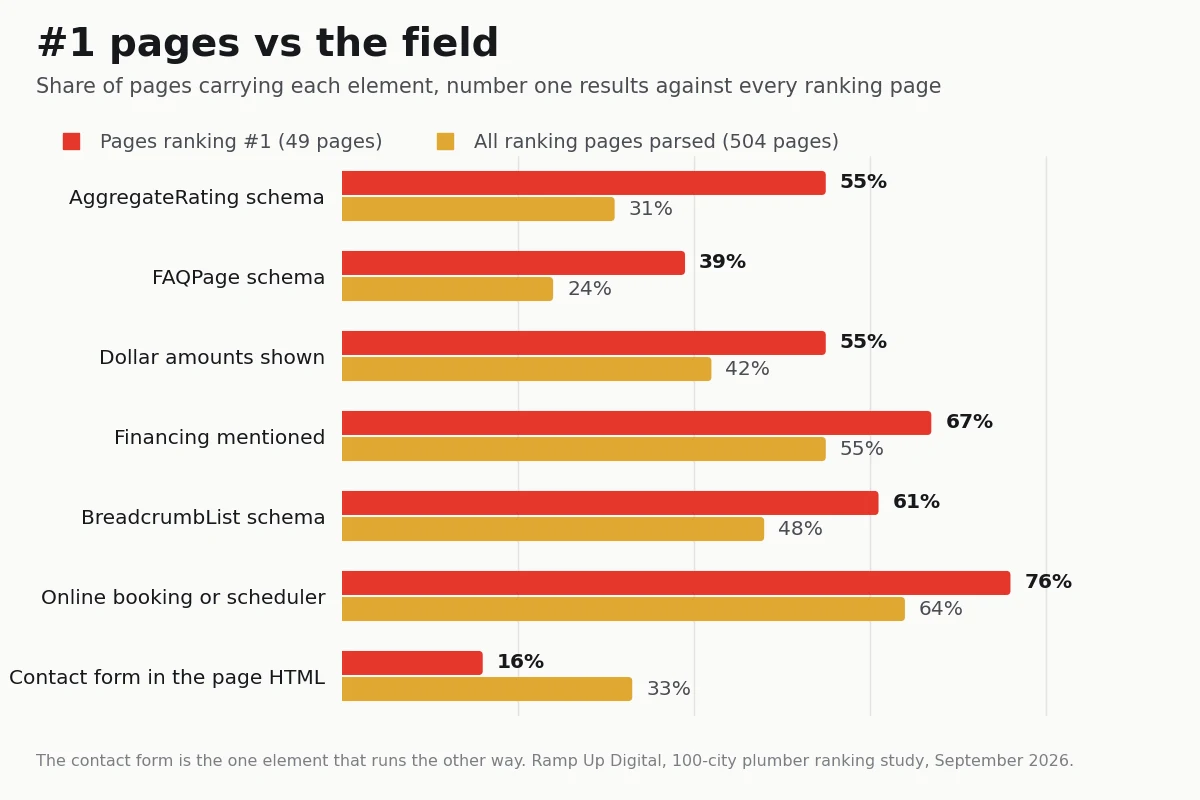
Six things separate the top pages from the rest of page one, and the chart below shows every one of them. AggregateRating schema appears on 55% of number one pages against 31% overall. Dollar amounts appear on 55% against 42%. Financing is mentioned on 67% against 55%. A years-in-business claim is on 90% against 80%. Top pages also run longer, a median 1,730 words against 1,521.
Source: our 100-city plumber ranking study.
The pattern is not "more SEO." It is a conversion layer. Prices, financing, a rating, answered questions: the things a homeowner needs before they will call a stranger about a flooded laundry room. The pages that win are the pages that answer the money questions on the page instead of hiding them behind a quote form.
Two caveats. This is correlation on a single capture date, not proof of causation, and a couple of factors move the other way: license numbers appear on 33% of number one pages against 38% overall, and top pages carry slightly fewer images. Also, before you bolt a star rating onto your own site, read the rule. Google's review snippet documentation states that when the entity being reviewed controls the reviews about itself, pages using LocalBusiness or other Organization structured data are ineligible for the star feature. The top pages tend to carry that markup. That does not mean marking up your own testimonials will earn you stars.
What This Study Does Not Prove
The study is an on-page snapshot, and it has limits. It looked at desktop, English-language results captured on one date, so seasonal and mobile differences are invisible in it. It measures what ranking pages contain, not what caused them to rank, so nothing here is a guarantee. And 185 of 876 pages could not be captured at all, almost all of them Yelp and Reddit pages, which we counted for ownership only. Treat the numbers as a map of the field, not a formula.
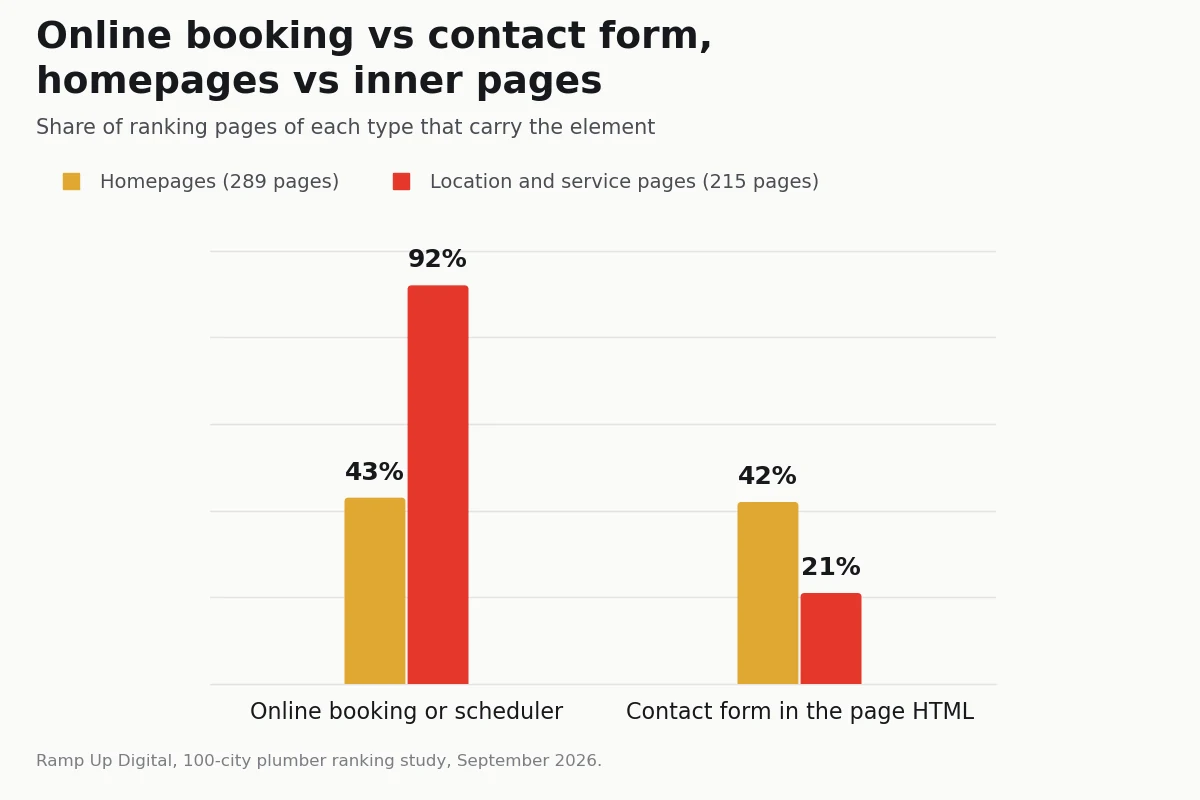
Schedulers have replaced forms on the pages that rank. An online booking or scheduling tool appears on 64% of ranking pages while a contact form appears in the HTML of only 33%. At number one the gap widens: 76% have booking, 16% have a form. The split by page type is sharper still, with booking on 92% of location and service pages against 43% of homepages.
Source: our 100-city plumber ranking study.
A form says "tell us about your problem and we will get back to you." A scheduler says "Thursday at 10 or Friday at 8." One of those matches how a homeowner with a leaking water heater thinks, and the pages at the top of these results have picked the same one. It is the same thing we find when we take apart plumber websites that get traffic but not calls.
Picture a Saturday morning. A homeowner finds two plumbers who both look fine. One page has a form with six fields and a promise of a callback during business hours. The other shows three time slots for Monday. She books Monday, closes the tab, and never contacts the first company at all. She was never comparing plumbers. She was comparing which page would end the problem faster.
Where you put the scheduler depends on where your traffic lands. If your homepage does most of your organic work, the scheduler belongs above the fold there, because homepages are the weakest performers on this in the whole data set. If your location and service pages carry the traffic, put booking on every one of them and keep a click-to-call link beside it, because emergency traffic will always prefer the phone.
Emergency and Scheduled Jobs Need Different Pages
Emergency searches and planned-work searches are two different products, and the data shows the winning pages treat them that way. Emergency and 24/7 language appears on 97% of ranking location and service pages against 84% of homepages. Dollar amounts appear on 67% of those inner pages against 25% of homepages, and financing on 82% against 35%. The urgency lives on the inner pages, and so does the money talk.
An emergency page is built for one action. Phone number at the top, availability stated in plain words, a short list of what you handle at 2 AM, light page weight, nothing between the reader and the call. A planned-work page is built for a decision that will take two weeks: a price range, timelines, permit realities, financing, and enough detail that the reader stops looking.
The mistake we see most often is one page trying to do both. It opens with a burst pipe photo and then spends 1,200 words explaining tankless efficiency. The emergency caller leaves because it is slow, and the researcher leaves because it never quoted a number.
One Page Per Service, and the Four Questions Each Answers
Every major service needs its own page, and each page has to answer four questions: what it costs, how long it takes, whether a permit is involved, and what the visit actually looks like. Only 42% of ranking pages show a dollar amount at all, rising to 55% at number one, and only 38% carry FAQ content. The bar here is lower than anyone assumes.
Drain cleaning, water heater repair and replacement, sewer line work, leak detection, gas lines, repipes and emergency service each deserve a page. A single "Services" page with a bulleted list targets nothing and ranks for nothing, which is the most common structural problem we find when we take over a plumbing site.
Take one water heater page. The old version was 200 words and said "call for a free estimate." The new one gives a replacement range in dollars, explains that a same day swap is normal but a tankless conversion means gas line and venting work, names the permit requirement, and shows financing. It is 1,900 words and it answers the questions people were leaving to go find. That page competes. The 200 word version never did.
Reviews, Ratings, and the Rule Most Plumbers Break
Reviews earn the rating, and the rating is the signal. AggregateRating markup sits on 55% of number one pages against 31% overall, and an embedded review widget appears on only 23% of ranking pages. The work is getting a rating and a review count worth showing, then putting them where a homeowner is deciding. The markup is the easy half. Getting there is a volume problem first, and it runs on a review engine rather than a one-off push.
The process is unglamorous and it works: the technician asks at the end of the job, a text goes out within a couple of hours with a direct link, every review gets a reply, and nobody is ever offered anything in exchange. That last part is federal law now. The FTC's rule on consumer reviews and testimonials makes it unlawful to provide compensation or other incentives conditioned on a review expressing a particular sentiment. A five dollar gift card for a five star review is now a legal problem, not a growth hack.
If you are under 20 reviews, volume is your whole job for the next quarter and the rating will take care of itself. If you are past 150 with a strong average, stop chasing count and start using what you have: reviews from a specific city placed on that city's page, responses that name the job that was done, and a widget on the pages where people decide.
The Gaps Nobody Has Filled Yet
Ten things stay rare across the whole field. Rare is where a smaller shop gets ahead.
| What the page has |
Share of ranking pages carrying it |
| Live chat widget |
5% |
| Video on the page |
15% |
| Maintenance plan or membership |
22% |
| Embedded review widget |
23% |
| FAQPage schema |
24% |
| AggregateRating schema |
31% |
| License number shown |
38% |
| Upfront or flat-rate pricing promise |
41% |
| Dollar amounts shown |
42% |
| Coupons or dollar-off offers |
46% |
Source: our 100-city plumber ranking study, 504 pages parsed.
Pick from that list based on what you can actually back up. A flat-rate shop should lead with the pricing promise, and a licensed shop with a long history should put the license number on the page. A shop with a maintenance plan has something four out of five competitors cannot show.
We rebuilt the site for a Hillsborough plumbing company on this logic: a fast page, a real service structure, and the trust details put where people look. It hit a perfect PageSpeed score and took a spot in the local 3-pack. Speed alone does not rank a page. It buys you the few seconds in which the rest of the page can do its job.
Measure Calls and Booked Jobs, Not Rankings
The only metrics worth reporting are calls, booked jobs, and revenue by source. Ranking number one for "plumber [city]" is worth nothing if the page does not produce calls, and our study cannot tell you whether a page converts, only what it contains. You have to instrument that yourself.
Track calls from search with call tracking split by source, form and scheduler submissions as conversions, booked jobs pulled back from your CRM, and cost per acquisition by channel. Knowing you took 50 calls from organic search is trivia. Knowing those 50 calls became 22 booked jobs is a budget decision, and cost per acquisition is what lets you compare this against Google Ads for plumbers honestly.
Here is the order we would work in:
- Search "plumber [your city]" from a logged out browser and write down who holds the top three spots and what page type each one is.
- Fix any missing template item on your main page, which is an afternoon, then stop touching it.
- Build or rewrite one location page or one service page to the 2,000 word standard, with a price range, a scheduler, and a rating on it.
- Turn on call tracking before that page goes live so you can tell what it did.
A plumbing client of ours saw leads rise fivefold working roughly this way. Not from one trick, and not quickly: from a page structure that matched how people search and a conversion layer that matched how they decide. What you end up holding is a lead source that does not switch off the day you stop paying for clicks.
Plumber SEO Questions We Get Asked
How long does plumber SEO take to show up in calls?
Plan on a couple of months for one new page and a couple of quarters for a rebuilt site. The template items are an afternoon and move nothing on their own. What moves calls is a location or service page at the 2,000 word standard, indexed and trusted.
Does a plumber need a blog?
Not for these searches. Blog posts take 1% of all local ranking slots, while location pages take 55% of the local number one spots. A blog earns its place on long-tail questions and links. For plumber plus your city, build a location or service page.
Should I put prices on my website?
Yes, at least a range. Dollar amounts appear on 55% of number one pages against 42% of the field, so they are both rare and associated with the top spot. A range, what changes it, and financing answer the question people leave your site to answer.
A Reddit thread outranks me. Is SEO pointless?
No, it narrows the target. A Reddit thread held the top spot in 35 of the 100 cities we checked and a local business held it in 49, so aim for the highest business slot. You cannot beat a forum thread with a forum thread. You beat the businesses under it.
Build Your Plumbing SEO Plan with Ramp Up Digital
The plumbing companies winning these searches are not running a secret. They are running a location page instead of a blog post, a scheduler instead of a form, and prices on the page instead of behind a quote request. If you would rather have someone build that than fit it around a full schedule of service calls, our SEO for plumbing companies work starts with exactly the audit above: who holds your city, what their page has, and what yours is missing.