Insights
SEO for Plumbers: What Actually Ranks in 100 Cities
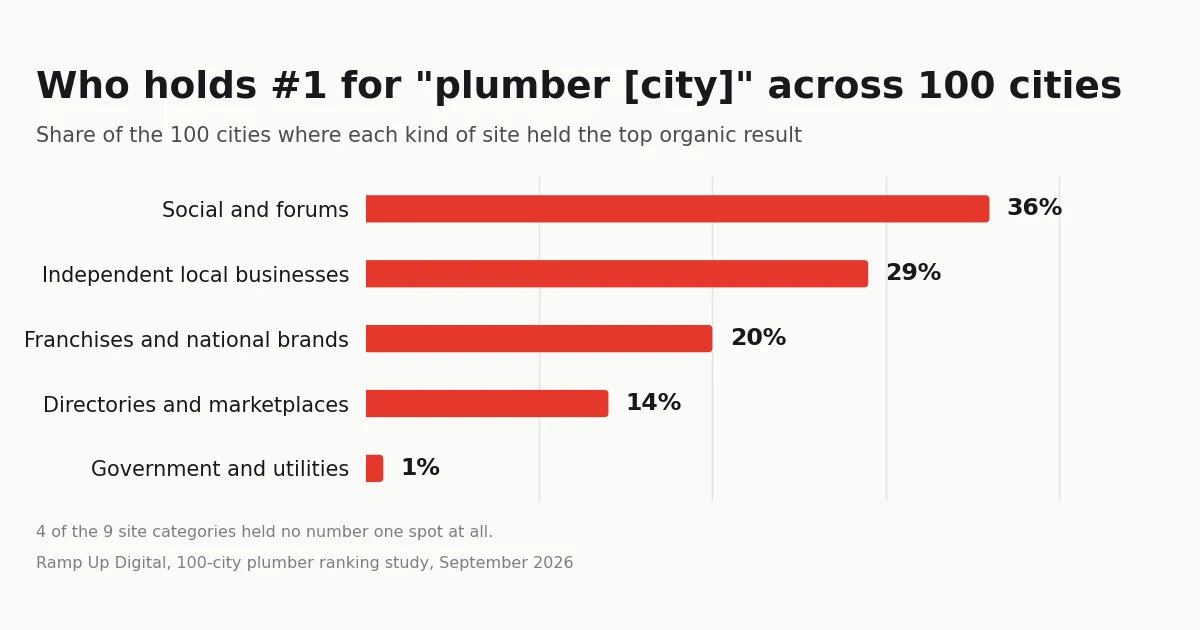
We parsed 880 ranking slots across 100 cities to see what really ranks for plumber searches. The page type, the template, the conversion layer, the gaps.
Sep 26, 2026|17 min read

Tree service SEO rests on four pillars: an optimized Google Business Profile with steady reviews, dedicated service pages for every job type (removal, trimming, emergency, stump grinding), city pages for every area you serve, and content built for the seasonal spikes when demand actually hits. Companies that have those four in place before storm season get the calls. Companies that don't spend the winter watching competitors get booked.
A storm hits the Bay Area overnight. By 6 AM, homeowners are searching "emergency tree removal near me." The tree service companies that appear in those results will be booked solid for the next two weeks. The ones that don't? They'll wonder why the phone isn't ringing.
That scenario plays out multiple times a year, and it illustrates the core truth about tree service SEO: when people need tree work, they need it now. They're not comparison shopping for weeks. They search, they call the first two or three companies they see, and they book whoever can come out fastest. If your company doesn't show up in those results, someone else gets the job.
This guide covers everything a tree service company needs to rank on Google in 2026 -- from the foundational stuff most companies skip to the AI search shifts that are quietly reshaping how customers find you.
Tree service demand isn't flat. It follows predictable seasonal patterns, and the companies that plan their marketing around these cycles consistently outperform those that don't.
This is the highest-urgency, highest-value period. Storms bring down branches and whole trees, and homeowners need immediate help. The searches during this window are dominated by emergency intent: "fallen tree removal," "storm damage tree service," "emergency tree removal near me."
What to do: Make sure your emergency service pages are live and optimized well before storm season starts. If you wait until December to build an emergency tree removal page, Google won't rank it in time. Build it in summer, let it index and gain authority, and it'll be ready when the storms hit. Increase your Google Ads budget during these months -- paid search is your fastest lever when organic rankings need backup.
Homeowners notice overgrown trees, branches encroaching on roofs, and trees blocking views. This is when trimming, pruning, and shaping searches peak. The intent is less urgent but the volume is high.
What to do: Publish content and update service pages around trimming, pruning, and canopy management. This is also the best time to push seasonal GBP posts with before-and-after photos from recent pruning jobs.
Lot clearing and larger removal projects tend to cluster here -- homeowners and developers planning construction, fire season prompting defensible space clearing, and fall cleanup before winter. Searches like "lot clearing service," "tree removal for construction," and "dead tree removal" rise during these months.
What to do: Make sure you have dedicated pages for lot clearing and large-scale removal. Feature project photos prominently. Property owners planning big jobs want proof you can handle them.
The key takeaway: Don't run the same marketing playbook twelve months a year. Align your content, your GBP activity, and your ad spend with the demand cycles your customers actually follow.
A homeowner with a tree on their roof and a homeowner who wants their oak trimmed next month are both searching Google, but they're searching with completely different intent. Your SEO needs to treat them differently.
Emergency searchers want speed and availability. They're looking for:
Target keywords for emergency pages: emergency tree removal [city], fallen tree removal near me, storm damage tree service [city], tree on house removal, 24 hour tree service
Routine searchers are planning ahead. They'll compare a few companies, read reviews, maybe get multiple estimates. They want:
Target keywords for routine pages: tree trimming service [city], tree pruning cost, stump grinding [city], tree removal estimate, arborist near me
The critical mistake is putting all of this on one page. You need separate pages for emergency services and for each routine service. One page can't rank for "emergency tree removal" and "tree trimming cost" simultaneously. Google wants to match searchers with the most relevant result, and a page trying to cover everything is relevant to nothing.
Your GBP determines whether you show up in the Map Pack -- those three local results Google displays above organic listings when someone searches for a tree service. For most tree service companies, the Map Pack generates more calls than any other source.
Your primary category should be Tree Service. This is non-negotiable -- it tells Google what your business is.
Add these secondary categories:
Don't add categories that don't describe your core services. Adding "Landscaper" when you don't do landscaping will dilute your relevance.
Google has confirmed that businesses with photos receive 42% more direction requests and 35% more website clicks. But not all photos help equally.
The photos that matter most for tree services:
Upload 5 to 10 new photos per month. Google rewards active profiles, and fresh photos signal that your business is operating and completing jobs regularly.
Treat your GBP posts like a mini social media feed. Post weekly about:
Each post should include a call-to-action linking to the relevant service page on your website. This drives traffic and signals to Google that your profile is active.
We touched on this in our post about common tree service marketing mistakes, but it's worth going deeper. Your service pages are the backbone of your tree service SEO.
Tree Removal -- Your most searched service. Cover what's involved, when a tree needs to come down (dead, diseased, storm damaged, too close to structure), and what homeowners should expect from the process. Include pricing context: "Tree removal costs vary based on size, location, and complexity. Most residential removals in [your area] range from $800 to $5,000+."
Tree Trimming and Pruning -- Explain the difference between trimming (removing overgrowth) and pruning (strategic cuts for tree health). Cover when to trim, how often, and the benefits. Mention that improper pruning damages trees -- this positions you as knowledgeable versus the guy with a chainsaw and a pickup truck.
Stump Grinding -- A lot of companies tack this onto their removal page. Don't. People search specifically for stump grinding, often after a different company did the removal and left the stump. This standalone page captures that separate search intent.
Lot and Land Clearing -- Target developers, property owners, and homeowners expanding usable land. This is a higher-ticket service that deserves its own page with project photos showing cleared lots.
Emergency Storm Damage -- We covered this above, but it's critical. Make this page conversion-focused: phone number everywhere, "available now" messaging, and photos of storm damage jobs you've handled.
This deserves its own section because most tree service companies massively undervalue their project photos.
Think about what Google wants to show searchers: the most helpful, relevant, and unique content for their query. Stock photos, generic descriptions, and recycled content don't help. But a photo of a massive oak leaning over a house, followed by a photo of that same house with a clean, open yard? That's unique. That's helpful. That's something no other website has.
Before-and-after photos do three things for your SEO:
Make it a habit: Every job, take a photo before you start and after you finish. It takes 60 seconds and creates marketing assets you'll use for years.
If you've searched Google recently, you've probably noticed AI-generated summaries appearing at the top of results for many queries. These AI Overviews are changing how local businesses get found.
For tree service searches, AI Overviews tend to appear on informational queries: "when should I trim my trees," "how much does tree removal cost," "signs a tree is dying." They're less common (for now) on high-intent local searches like "tree removal near me," where Google still defaults to the Map Pack and traditional results.
Informational content matters more than ever. If you have a blog post that thoroughly answers "how much does tree removal cost in [your area]," Google may pull from that content in its AI Overview -- putting your brand in front of searchers before they even click a link. Companies that invest in helpful, detailed content are getting visibility that pure service-page websites miss entirely.
Structured data helps you get cited. When your pages use proper schema markup and organize information with clear headings, lists, and direct answers, AI Overviews are more likely to reference your content.
Local trust signals still win. AI Overviews for local service queries pull heavily from Google Business Profiles, reviews, and locally-relevant content. The fundamentals we've covered -- GBP optimization, reviews, local service pages -- feed directly into AI search visibility.
The tree service companies that will thrive in AI-powered search are the ones building genuine authority: real project documentation, honest pricing guidance, and expert advice that homeowners actually find useful. That's always been good SEO. AI search just rewards it more.
Reviews are a ranking factor, a trust signal, and a conversion driver all in one. For tree services, where customers are often spending thousands of dollars, reviews can be the difference between getting the call and losing it to a competitor.
The best moment to ask for a review is right after the job is complete, while the crew is still on site. The homeowner is looking at a clean yard where a dangerous tree used to be. They're happy. They're relieved. That's the emotional peak -- and that's when they're most likely to leave a glowing review.
Send a text message with a direct link to your Google review page. Don't ask them to "find you on Google and leave a review." That's too many steps. A direct link takes them straight to the review form.
Include the before-and-after photo with the message. Something like: "Thanks for trusting us with your tree removal! Here's the finished result. If you're happy with the work, we'd really appreciate a Google review: [link]." The photo reminds them of the transformation and triggers a positive emotional response right before they write their review.
Feature them on your service pages. A tree removal page with three customer reviews embedded directly in the content performs significantly better than one without. Pull quotes from reviews that mention specific services and locations: "They removed a 60-foot eucalyptus from our backyard in Redwood City. Professional crew, cleaned up everything." That review is practically an SEO keyword and a testimonial in one.
SEO for tree services isn't one tactic. It's a system: GBP optimization feeding the Map Pack, service pages capturing search intent, photos and content building authority, reviews building trust, and all of it working together to put your company in front of homeowners when they need you.
The companies that do this consistently -- not perfectly, but consistently -- are the ones that stop relying on word of mouth and start getting a predictable flow of calls from Google every month.
If you're a tree service company in the Bay Area looking to grow, we can help. We manage local SEO for service businesses across San Mateo County and the wider Bay Area, and we've seen firsthand what moves the needle for tree services.
Contact us for a free SEO audit and we'll show you exactly where you're leaving leads on the table.
Keep Reading

