Insights
SEO for Plumbers: What Actually Ranks in 100 Cities
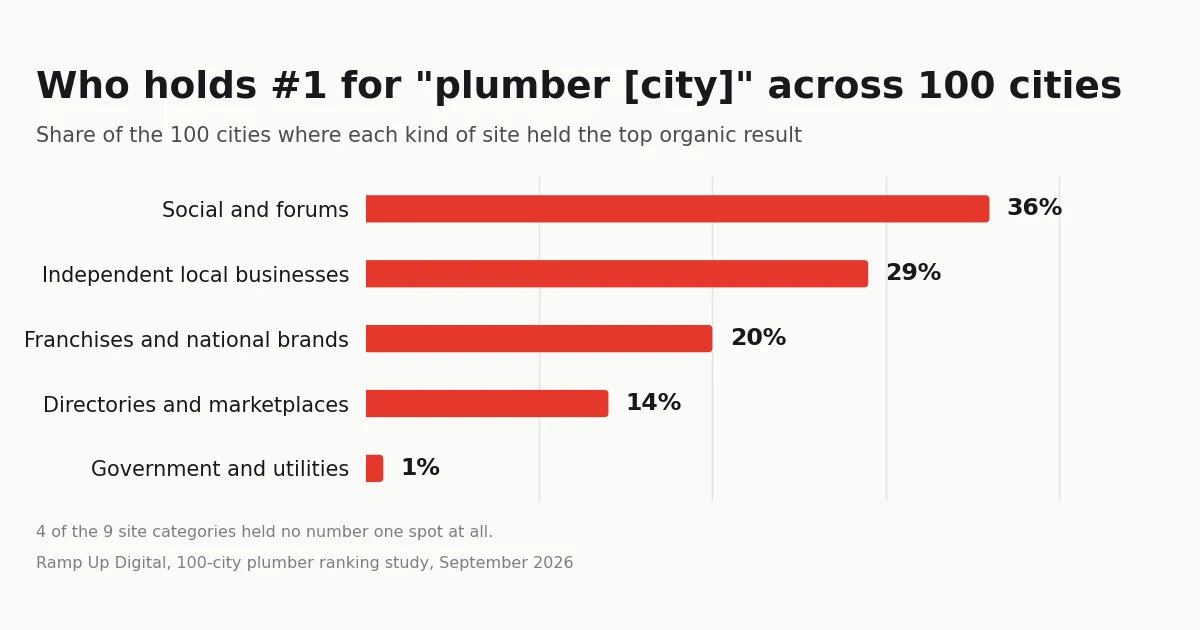
We parsed 880 ranking slots across 100 cities to see what really ranks for plumber searches. The page type, the template, the conversion layer, the gaps.
Sep 26, 2026|17 min read

HVAC companies that rank on Google get calls. The ones that don't get passed over for the competitor who does. That is the entire business case for HVAC SEO, and it is not complicated -- but executing it well requires understanding the specific dynamics of how homeowners search for heating and cooling services.
We run SEO and Google Ads for local service businesses across the Bay Area, including plumbing companies that also do HVAC work. The overlap between plumbing and HVAC SEO is real -- many of the same principles apply -- but HVAC has its own seasonal patterns, search intent dynamics, and competitive landscape that demand a dedicated strategy.
This guide covers what actually works for HVAC digital marketing in 2026, based on the campaigns we manage and the data we see every day.
In markets with brutal summers or freezing winters, HVAC search volume follows an obvious pattern: AC searches spike in June, furnace searches spike in December. Simple.
The Bay Area breaks that pattern. Our mild climate means fewer extreme-weather emergencies, which changes the entire SEO calculus:
This matters because most HVAC marketing advice assumes a predictable two-peak seasonal cycle. If you are serving San Mateo, Santa Clara, or Contra Costa County, you need a more nuanced content calendar that accounts for micro-seasons and weather-driven demand spikes.
Map your content publishing to search demand, not the calendar:
The HVAC companies that publish seasonal content before the demand spike -- not during it -- are the ones that capture the traffic. Google needs time to crawl and rank your pages. Publishing a furnace repair guide in December is too late.
This is the single most important distinction in HVAC SEO, and it mirrors what we see in plumbing SEO. Your potential customers fall into two buckets, and each requires a different approach.
Someone searches "AC not working" or "no heat emergency repair" at 10 PM. They are not reading blog posts. They are not comparing three quotes. They want a phone number, confirmation you are available now, and confidence that you can fix the problem.
What emergency intent pages need:
Someone searches "best HVAC company for heat pump installation" or "furnace replacement cost Bay Area." They are researching. They will visit multiple sites. They might not call for days or weeks.
What maintenance and installation pages need:
Building separate pages for these two intent types is not optional. A single "HVAC Services" page cannot serve both the panicking homeowner and the careful researcher. It will convert neither well.
For most HVAC companies we have analyzed, the Google Business Profile drives more calls than the website itself. When someone searches "HVAC repair near me," Google shows the Map Pack before any organic results. If you are not in that Map Pack, you are invisible for the highest-intent searches.
The GBP fundamentals for HVAC companies:
For a deeper dive on Map Pack strategy specifically, read our guide on how to rank in Google Maps. Everything in that guide applies directly to HVAC.
Two HVAC companies with similar GBP optimization will be separated by reviews. The company with more recent, higher-rated reviews wins the Map Pack placement almost every time.
Here is how to systematize HVAC reviews:
The HVAC companies that treat review generation as a system -- not something they remember to do occasionally -- build an insurmountable lead over competitors who ignore it.
Your website needs dedicated pages for every major service you offer. Not a bulleted list on a single page. Not a dropdown menu. Individual, indexable pages that Google can rank for specific searches.
Core HVAC service pages you need:
Each page should include:
If you serve 20 cities, you need location-specific content -- but do not create 20 identical pages with only the city name changed. Google penalizes thin, duplicated content. We have seen HVAC companies lose rankings after launching 30 cookie-cutter city pages.
The right approach: create location pages only for your primary service cities (5 to 10), and write genuinely unique content for each one. Mention local landmarks, specific climate conditions (inland valley vs. coastal), and the types of HVAC systems common in that area's housing stock. A page about HVAC service in Palo Alto should reference the older homes with radiant heating. A page about Concord should mention the 100+ degree summer days that stress AC systems.
SEO takes time. If you need calls next week, Google Ads for HVAC is the fastest path. But it is also the fastest way to burn money if you set it up wrong.
We manage Google Ads alongside SEO for our service-business clients, and the two channels work best together. For a detailed comparison of when each makes sense, read our breakdown of SEO vs. PPC for local businesses.
Use Google Local Service Ads (LSAs) first. LSAs show above traditional search ads with a "Google Guaranteed" badge. For HVAC, LSAs typically deliver the lowest cost per lead -- often $25 to $60 per call, compared to $40 to $120+ for standard search ads. You pay per lead, not per click, which eliminates wasted spend from tire-kickers.
Separate campaigns by service type. Do not lump AC repair, furnace installation, and duct cleaning into one campaign. Each service has different keyword costs, different conversion rates, and different seasonal demand. You need the ability to shift budget independently.
Bid aggressively on emergency keywords. "AC repair near me," "emergency furnace repair," and "HVAC not working" have high CPCs but also the highest conversion rates. Someone searching these terms is ready to hire right now. The ROI on emergency keywords almost always justifies the cost.
Use negative keywords relentlessly. "HVAC jobs," "HVAC salary," "HVAC training," "DIY AC repair" -- these searches will eat your budget if you don't exclude them. Review your search terms report weekly for the first month, then monthly after that.
Daypart your non-emergency campaigns. If you do not offer after-hours service for non-urgent work, do not run your maintenance and installation campaigns at midnight. Save that budget for business hours when someone can answer the phone.
Standard search campaigns should be your foundation, but consider these additional HVAC advertising ideas:
Blog content for HVAC companies serves two purposes: capturing long-tail search traffic and building topical authority that helps your service pages rank higher. But most HVAC blogs are ghost towns with three posts from 2019.
Content that actually drives traffic and leads:
"How to Prepare Your Furnace for Winter in the Bay Area" targets a real search query, provides genuine value, and naturally links to your furnace maintenance service page. Publish these before each season and update them annually.
"Heat Pump vs. Furnace: Which Is Right for Bay Area Homes?" answers a question that homeowners in the research phase are actively searching. These posts attract high-quality traffic from people who are close to making a purchase decision.
"Why Is My AC Blowing Warm Air?" captures emergency-adjacent search traffic. Someone searching this might try a DIY fix, or they might realize they need a professional. Either way, your brand is now in front of them.
"Best HVAC Systems for Older Homes in San Mateo" or "Do You Need AC in Half Moon Bay?" These posts target micro-queries that your national competitors will never bother with. The search volume is small per post, but collectively they add up, and they signal geographic relevance to Google.
Do not write generic posts like "The Importance of HVAC Maintenance" or "5 Benefits of a New AC System." These have been written a thousand times by every HVAC company and manufacturer in the country. You will never rank for them, and they do not help your local SEO.
Many companies offer both plumbing and HVAC services. If that is you, there is a significant plumbing and HVAC SEO advantage: you can build topical authority across both verticals faster than a single-trade company.
How to leverage the overlap:
We cover the plumbing side in detail in our SEO for plumbers guide. If you do both trades, read that alongside this post and build a strategy that connects the two.
The Bay Area HVAC market has characteristics that national guides do not account for:
Mild climate reduces emergency volume. Compared to Phoenix or Houston, the Bay Area generates fewer "my AC died in 110-degree heat" emergencies. This means your SEO strategy needs to lean harder on maintenance, efficiency, and installation intent rather than relying on emergency calls alone.
Energy efficiency matters more here. Bay Area homeowners are more likely to search for "energy-efficient HVAC," "heat pump vs furnace efficiency," and "HVAC rebate programs." California has aggressive energy efficiency rebates and incentives through programs like BayREN and utility-specific offers. Content about rebates and energy savings performs exceptionally well in this market.
Housing stock varies dramatically by city. A 1950s ranch in San Mateo has completely different HVAC needs than a 2020 townhome in Milpitas. Victorian homes in San Francisco often lack ductwork entirely, making mini-splits the go-to recommendation. Your content should reflect this local knowledge -- it is something national competitors cannot replicate.
High competition, high reward. HVAC jobs in the Bay Area command premium pricing. A furnace replacement that costs $4,000 in the Midwest can be $7,000 to $10,000 here. That means the lifetime value of an SEO-generated customer is significantly higher, which makes the investment in HVAC SEO more justifiable than almost any other market.
HVAC companies should track three metrics from their SEO efforts:
Vanity metrics like total website traffic or "number of keywords ranking" can be misleading. An HVAC company ranking for 500 keywords that does not generate phone calls has an SEO problem, not an SEO success.
If you run an HVAC company in the Bay Area and your phone is not ringing from Google, the problem is almost certainly one of the issues covered in this guide: a neglected Google Business Profile, missing service pages, no review strategy, or seasonal content that does not exist.
Here is where to start:
Or skip the self-audit and let us do it. Ramp Up Digital runs SEO and Google Ads for local service businesses across the Bay Area. We will tell you exactly where you are losing leads and what it will take to fix it. See our full approach to SEO for HVAC companies, or get in touch for a free HVAC marketing audit.
Keep Reading

