Insights
SEO for Plumbers: What Actually Ranks in 100 Cities
We parsed 880 ranking slots across 100 cities to see what really ranks for plumber searches. The page type, the template, the conversion layer, the gaps.
Sep 26, 2026|17 min read

Someone planning a move does not search the way someone with a burst pipe does. They call three or four movers in one sitting, book whoever answers and sounds honest, and spend half of every call trying to work out whether you are a real moving company or a broker who will sell their job to a stranger. Most SEO advice for movers ignores all of that and hands you the same checklist a dentist gets.
I run SEO for service businesses at Ramp Up Digital, including a Bay Area moving company with three locations that serves more than 40 cities. This guide draws on that account's Search Console data, a teardown of the pages ranking for this search in October 2026, and a dozen Reddit threads where moving company owners compare notes on what worked and what burned them.
When I say moving company SEO, I mean both the map pack that sends local calls and the organic pages that win long-distance and commercial jobs. It covers the two-truck crew in one town and the carrier running interstate routes.
If you just started and have a handful of reviews, you want to know what to do first without paying for things that do not matter yet. If you have ranked for years and the phone has gone quiet anyway, you want to know what changed. And if you run several locations or long-distance routes, you want to rank across a whole region without building pages Google will ignore.
By the end you will know how movers actually get searched, the six ways generic local SEO goes wrong for them, the pages and profile settings that book jobs, and which gap to close first in your situation. It runs in four parts: how customers shop, why the standard playbook fails, what to build, and how to audit and prioritize. One client's ranking history closes it out as the proof, including the part that did not go well.
Start with the customer, because everything else follows from how they shop.
People shopping for a mover search in short bursts, call several companies, and book on trust and speed more than on price. Five habits shape what your SEO has to do.
They call around, and the first good answer wins. A move is a one-off purchase with a deadline. Owners in a long r/PPC thread about mover leads said most of their leads arrive by phone and that customers tend to book whoever picks up first. I can't verify their numbers, but the logic holds. Someone who needs a crew on the 30th does not wait for a callback.
They are afraid of being scammed. Moving fraud is common enough that the federal regulator runs a whole program about it. The FMCSA's Protect Your Move site teaches consumers to check a mover's registration, spot red flags, and tell movers from brokers. Even prospects who never read it have heard a horror story from a friend.
They often can't tell a mover from a broker. Brokers buy ads and rank pages for "movers [city]", take a deposit, then sell the job to a carrier. People on r/moving describe calling what looked like a local company and being handed off to someone else. Every honest carrier pays for that distrust on the first call.
Local and long-distance are different searches. "Movers near me" and "movers San Jose to Austin" return different results, different competitors, and need different pages. One page cannot win both.
The search has a date attached. People search when a lease ends or a closing date lands. Most movers see a summer rush, which means the pages that catch it have to be ranking in spring, not written in June. Our moving company marketing ideas post lays out what to do in the slow months.
Generic local SEO assumes one location, one service radius, and customers who pick the first decent result. Movers break all three assumptions, and that shows up as six failure modes.
1. One Google Business Profile asked to cover a whole metro. Map pack results lean heavily on how close the business is to the searcher. In an r/localseo thread, a Northern Virginia mover with one profile about 30 miles from the city core asked why he didn't show up in DC. An agency owner replied that you can't rank in DC from Manassas. No amount of optimization moves your pin. Good work makes you the strongest result inside the radius you really have, which is what our Google Maps ranking work is built around.
2. City pages that only swap the name. You serve 40 towns, so someone builds 40 pages with the same three paragraphs and a new city in the H1. Google's spam policies call these doorway pages. At best they get ignored. At worst they drag down the pages that were working.
3. Treating lead sites as the strategy. Yelp, Thumbtack and Angi can fill a calendar, but the leads are usually shared. One owner on r/sweatystartup posted an Angi offer of $525 a month for 24 to 40 leads, with a one-year contract and an early exit fee of 35% of the remaining balance. Commenters who had tried similar deals said most of those leads never picked up. We compare the numbers in Google Ads vs. lead services for moving companies.
4. Measuring rankings instead of booked moves. A new owner in r/PPC said he hit number one for a keyword after two months of his own SEO and got four leads a month from it. Rankings for low-volume terms look good in a report and do little for revenue.
5. A blog full of packing tips. "How to pack a kitchen" attracts people who already hired a mover or plan to do it themselves. It rarely books a job.
6. Ignoring the trust layer. If your site never shows a USDOT number, a state permit, or proof that you run your own trucks, you look exactly like the brokers your customer is trying to avoid.
If an agency pitch or monthly report does any of the following, it was built for some other trade:
Nearly every moving job comes through one of three search patterns: a local "call now" search, a long-distance route search, or a trust check on a company the customer already found. Each one is won in a different place.
| Search pattern | Typical searches | Where it is won | What wins it |
|---|---|---|---|
| Local call now | movers near me, movers [city], local movers [neighborhood] | Map pack and Local Services Ads | Proximity, review count and recency, an answered phone |
| Long-distance route | movers [city] to [state], cross country movers [city] | Organic results, often crowded with brokers | Route pages for routes you really run, carrier proof |
| Trust check | [company] reviews, is [company] legit, movers vs brokers | Your profile, review sites, your own pages | Consistent name and numbers everywhere, a clear licensing page |
Most moving company SEO plans for the first row and stops there. The second row is where carriers can beat brokers, because a broker can't show a truck or a crew. The third row decides whether all the other work turns into a booked job.
If you only do local moves, put almost all your effort into row one and row three. If you run interstate routes, row two is where your margin is.
The pages that book moves are fewer and stronger than most movers expect: one hub per real service region, cost pages built from your own jobs, route pages if you go long distance, a page per service, and one trust page.
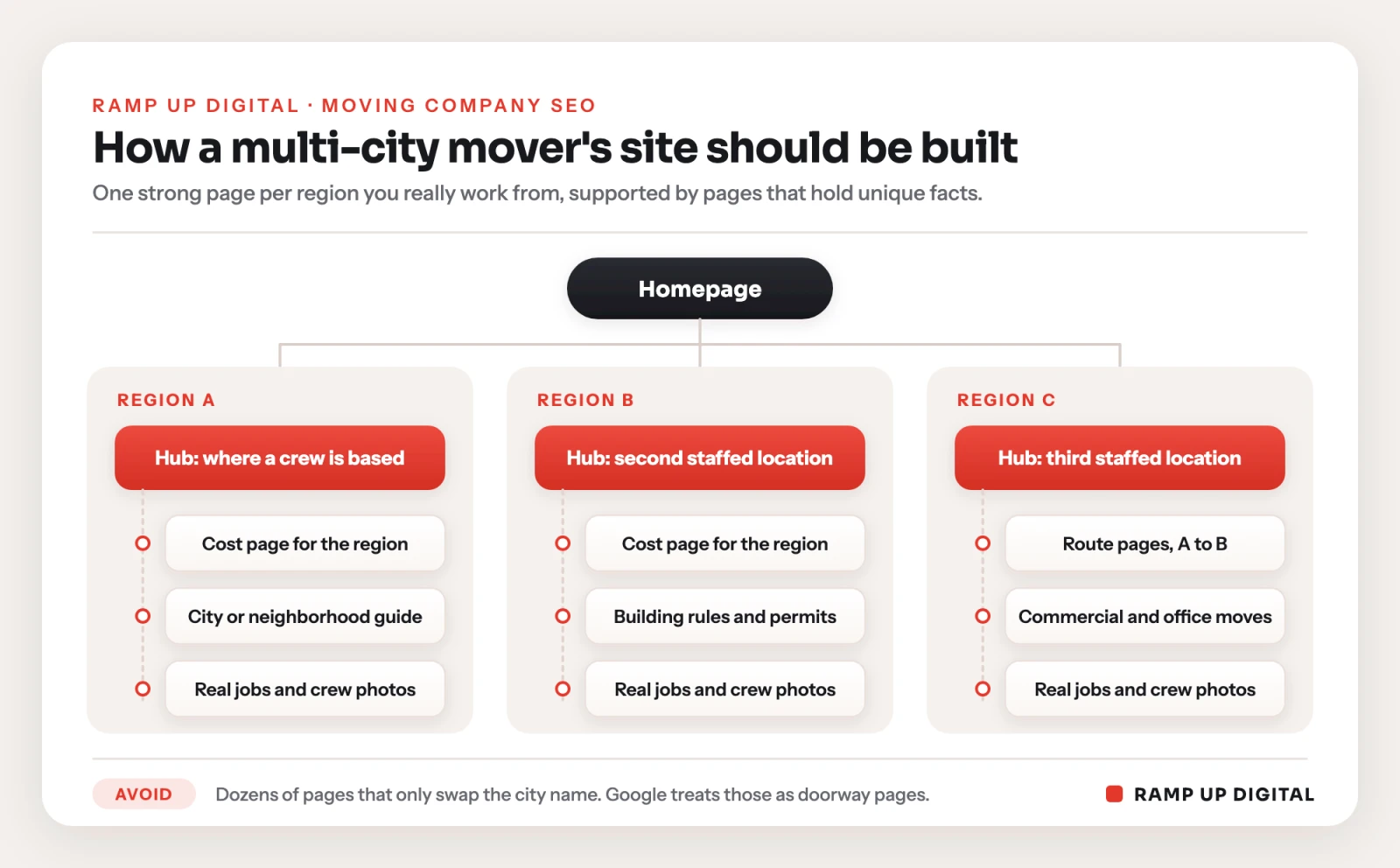
Build one substantial page for each region you actually work from, not one per town. Our Bay Area client works out of three locations, so the site has three regional hubs. Each one covers the towns that crew serves and the problems moves there actually involve: narrow streets and permit parking in one area, larger suburban homes and longer drives in another. Supporting pages link back to the right hub.
The swap test keeps you honest. If you can swap the city names on two of your pages and the text still reads correctly, those are doorway pages.
"How much does it cost to move a two-bedroom in [city]" is the most useful page a mover can publish, and most get it wrong by copying national averages. Use ranges from your own invoices. Explain what moves the price: stairs, elevators, distance between stops, packing, and the day of the month. A page that admits a range and explains it builds more trust than a calculator that spits out one suspiciously low number.
If you run interstate moves, build a page for each route you actually run often, such as "Bay Area to Austin." Cover typical transit time, how you price the route, and whether your own trucks and crews do the whole move. Do not build routes you broker out. The page only works because it is true.
Local moves, long-distance moves, commercial and office moves, labor-only loading help, storage, and specialty items like pianos and gun safes each get searched separately. Each deserves its own page with real details, such as hourly minimums for local work or after-hours scheduling for offices.
Most movers skip the trust page, and that makes it the cheapest win here. Put these on it:
Your profiles should match your real, staffed locations. Most moving companies should also hide their street address and set a service area, because crews go to the customer. That one rule prevents most of the suspensions movers run into.
Google's guidelines for representing your business say a location must be staffed during its listed hours. They also say virtual offices aren't eligible. That puts the common shortcuts, a coworking desk or a crew lead's garage, on thin ice. In the r/localseo thread above, the owner turned down a suggestion to open profiles at rented offices because he thought it broke the rules. He was right to.
The other rules movers break most often:
For the full setup, read our Google Business Profile guide and our playbook on getting more Google reviews.
Technical SEO for movers is mostly about the quote path on a phone. If a customer can't call or request a quote in a few taps, speed scores and schema won't save the page.
Most standard local SEO still applies to movers. It just has to be pointed at the moving customer's fears and timing. Here is how each practice changes.
| Practice | The generic version | The mover version |
|---|---|---|
| Reviews | Ask happy customers for a review | Ask the same day, link to the location that did the job, and invite customers to name the crew |
| Citations | List on as many directories as possible | Make your name match your USDOT record exactly on BBB, Yelp and your profiles (citation building covers the cleanup) |
| Links | Guest posts and directories | Realtors, property managers, storage facilities and corporate relocation teams who refer moves |
| Content | Weekly blog posts | Cost, route, and building-rules pages people use to plan a move |
| Site speed | Chase a perfect score | Make the quote form and phone number fast on a phone |
| Expertise | A generic About page | A named owner, years in business, licensing, and real crew photos |
The links row deserves a second look. In an r/LeadGeneration thread about long-distance leads, the advice was that past customers rarely move again for years. Realtors, apartment managers and HR teams send moves every month, and a link from their sites is worth more than a dozen directory listings.
AI answers tend to reward the same signals a cautious customer checks: a business that is consistent everywhere, reviewed recently across platforms, and specific about what it does and where. For movers, that rewards honest carriers.
I'll be straight about the evidence. Google showed no AI Overview for "seo for moving companies" when I checked in October 2026. We have not yet measured how ChatGPT or Google's AI answers pick movers across many cities. So read this section as how these systems work. It is not a study.
Three things still matter:
For more, read how to get cited in Google AI Overviews and our AI search optimization guide.
You can audit the parts that matter most in about an hour with six checks. Do them in order.
What to fix first depends on where your company is today. Pick the branch that sounds most like you.
Get the foundation right before you buy content. Set up one accurate profile at your real location and start a review request that goes out after every job. Build a homepage, a page per service, and a trust page. While SEO builds, use Local Services Ads or Google Ads for calls, so you are not stuck relying on shared leads. Skip the content package for now.
Look at what you rank for before you chase more. In Search Console, sort your queries by impressions. Check whether you rank for money terms or mostly for your brand and minor searches. Then check the phone: missed calls, slow callbacks, and voicemail during business hours. Then compare your review recency with the map pack. Flat calls with steady rankings usually trace back to one of those three things.
Build one hub per staffed location, send each review to the right profile, and add route pages for the interstate lanes you actually run. Add commercial and office pages if those jobs are worth more to you. Don't add profiles where you have no staffed location. The proximity limit is real, and the suspension risk is not worth it.
SEO for a mover is not a project you finish. The chart below tracks our Bay Area client's average Google position for "movers palo alto," month by month, from their own Search Console data.
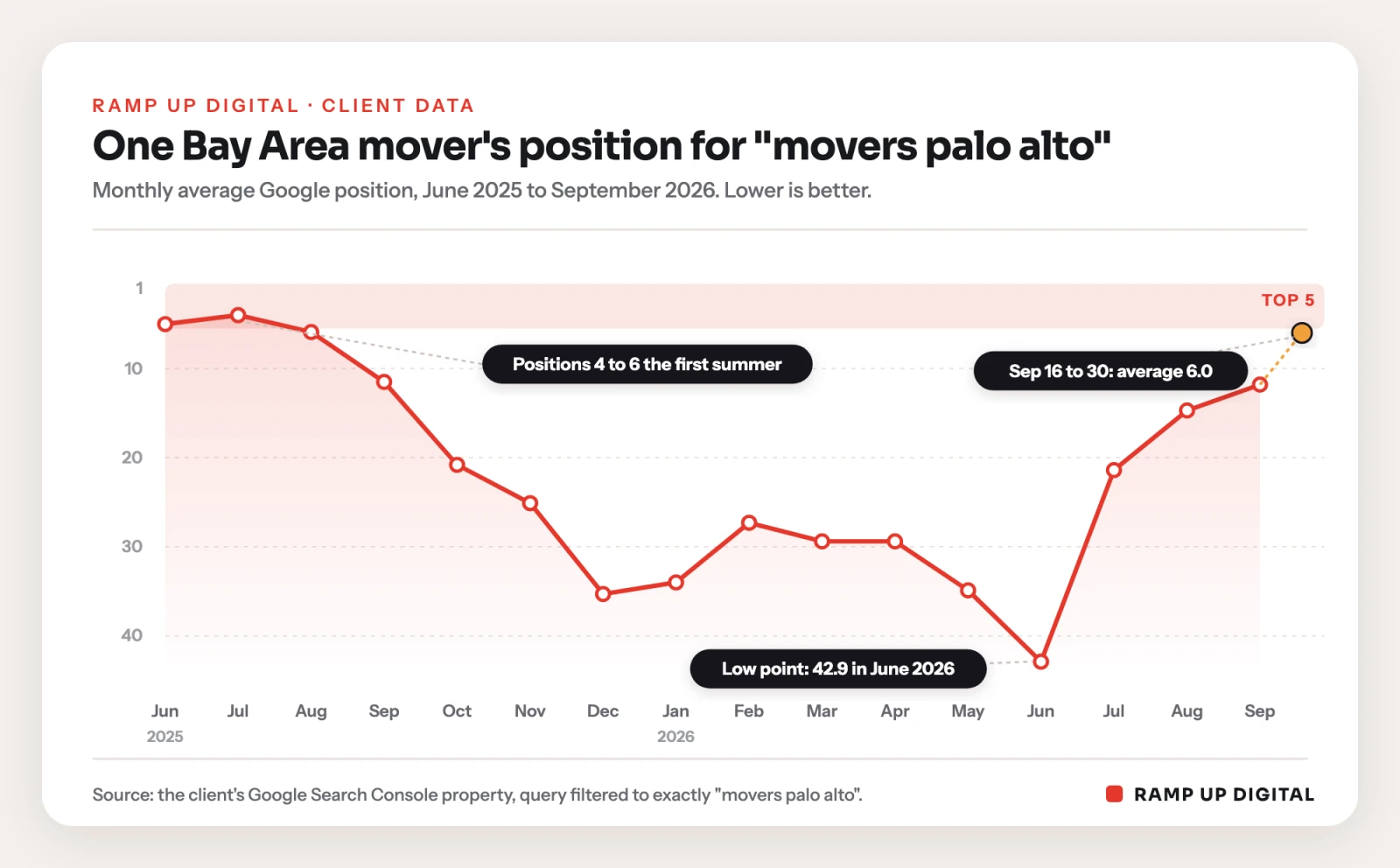
The early work paid off quickly. The site reached page one within about four months, and monthly calls tripled. Through summer 2025 it averaged between positions 4 and 6.
Then it slipped. From the fall, the average slid down the results and sat in the 20s to 40s for most of a year, bottoming out at 43 in June 2026. Since July it has climbed back. It averaged position 6 in the second half of September and sat in the top five on most days.
| Period | Average position for "movers palo alto" |
|---|---|
| June to August 2025 | 4.0 to 5.9 |
| December 2025 | 35.3 |
| June 2026 | 42.9 |
| August 2026 | 14.7 |
| September 16 to 30, 2026 | 6.0 |
I won't pretend the chart proves a clean cause and effect. Rankings for a competitive city term move with competitors, Google updates and your own work, all at once. What it does show is that a top spot earned in one season is not owned. The movers that hold the map pack keep reviews coming every week, keep their pages current, and check their money terms every month instead of every year.
Expect a few months before calls change and six months or more to compete for the biggest terms in a large metro. Our Bay Area client reached page one for its main city term in about four months. A new company with few reviews in a crowded market should plan for longer and use paid search for calls while SEO builds.
It depends on how many locations you run and how competitive your market is. Our own SEO plans start at $497 a month with no contract. Our guide to what SEO costs a small business breaks down the rest. Whatever you pay, ask for a report on calls and booked moves rather than rankings alone.
Usually not. Build one strong page per region you really work from, and add a city page only when you have unique things to say about that city, such as building rules, parking permits, real jobs and reviews from customers there. Pages that only swap the city name are doorway pages and tend to get ignored.
Only if you have a real location there that is staffed during your listed hours. Google's guidelines say virtual offices aren't eligible, and movers who bend this rule risk suspensions that can take months to undo. Cover nearby towns with your service area and your regional pages instead.
They can fill gaps, especially when you are new, but treat them as rented attention. The leads are usually shared with other movers, so speed to answer decides who wins them. Read the contract terms before signing, and keep building the profile and site you own.
If you move household goods across state lines, yes. Federal rule 49 CFR 375.207 requires your name and USDOT number in all advertisements. It also builds trust, because careful customers look it up. Check your state's rules for local moves, because some states issue their own permit numbers.
No. A domain like citymovers.com gives you little ranking help on its own, and redirecting one to your main site passes no keyword benefit. Your brand name is what customers see on the truck, hear from referrals and search for later, so build on it.
If you want a second set of eyes on your moving company's SEO, start with the free SEO checker. If you would rather we handle it, from profiles and reviews to regional pages and tracking, start a project and tell us where you operate. We will show you where the calls are leaking and what we would fix first.
Keep Reading

