Insights
SEO for Plumbers: What Actually Ranks in 100 Cities
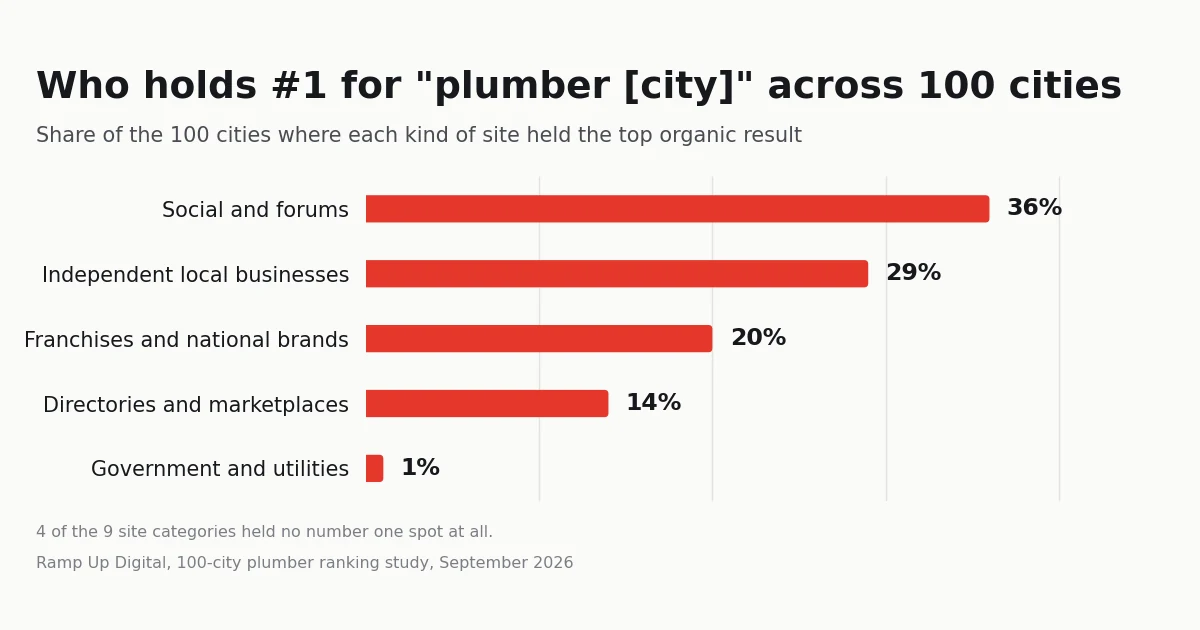
We parsed 880 ranking slots across 100 cities to see what really ranks for plumber searches. The page type, the template, the conversion layer, the gaps.
Sep 26, 2026|17 min read
Google AI Overviews keep expanding into local searches. ChatGPT and Perplexity are now search channels. Here's exactly how to optimize your business for the AI search era.

Search has not changed incrementally. It has changed fundamentally.
If you are a local business owner still thinking about SEO the way you did two years ago --- chasing keyword rankings, publishing thin blog posts, hoping your website climbs the blue links --- you are optimizing for a search landscape that no longer exists. The ground has shifted beneath you, and most businesses have not noticed yet.
Google AI Overviews now dominate the top of search results for the majority of local queries. ChatGPT and Perplexity have emerged as legitimate search channels where millions of people find and choose local businesses every day. And the old playbook --- the one that worked reliably from 2015 to 2023 --- is broken.
This is not a prediction. This is what is happening right now, in April 2026. The businesses that understand this shift and act on it will own local visibility for the next decade. The rest will wonder where their leads went.
Let's be direct about what no longer works.
Keyword stuffing is dead. Not "less effective." Dead. Repeating "plumber San Mateo" fourteen times on a page does not help you rank. Google's AI systems understand language semantically now. They know what your page is about without you hammering the same phrase into every paragraph. Pages that still do this are actively deprioritized because they signal low-quality, manipulative content.
Thin content is invisible. Publishing a 400-word blog post titled "Why You Need a Good Plumber" with generic advice pulled from common knowledge does nothing. AI systems are trained to recognize content that adds no unique value. If your page says nothing that a hundred other pages don't already say, AI will never cite it, never surface it, never send a single customer your way.
Generic service pages are commoditized. "We offer quality service at affordable prices" is not a differentiator. It is noise. Every competitor says the same thing. AI systems cannot distinguish your business from anyone else when your content reads like a template.
Link schemes are risky and less impactful. Buying links from irrelevant directories or participating in link exchanges carries more downside risk than ever. Google's AI can evaluate link quality with far more sophistication than its previous algorithm. Authority is now built through genuine mentions, citations, and topical relevance --- not purchased PageRank.
Most agencies have not adapted to this reality. Most will not until it is too late. They are still selling keyword ranking reports and monthly blog posts as if the search landscape of 2023 is coming back. It is not.
To optimize for AI search, you need to understand what has changed mechanically. Three major AI search systems now determine how customers find local businesses.
When someone searches "best Italian restaurant near me" or "emergency dentist San Mateo," Google no longer just shows a list of ten blue links. It generates an AI-powered summary at the top of the page --- an AI Overview --- that synthesizes information from across the web to directly answer the query.
This AI Overview pulls from your Google Business Profile, your website content, your reviews, directory listings, and structured data. It decides, in real time, which businesses to mention and which to skip. If your business information is inconsistent, incomplete, or generic, the AI Overview will feature your competitors instead.
The critical thing to understand: AI Overviews do not rank pages. They cite entities. Google's AI builds an understanding of your business as a real-world entity --- what you do, where you operate, how customers rate you, what makes you different --- and decides whether that entity is relevant to the query. This is a fundamentally different model than traditional ranking.
ChatGPT is now a search engine. Millions of people type queries like "recommend a good accountant for small business taxes in Redwood City" directly into ChatGPT. It synthesizes information from across the web and provides recommendations with citations.
ChatGPT does not crawl the web the same way Google does. It relies heavily on authoritative, well-structured content and trusted sources. If your website content is detailed, specific, and clearly demonstrates expertise, ChatGPT is more likely to cite you. If your content is generic marketing copy, it will cite your competitor who wrote the definitive guide to small business tax preparation in San Mateo County. ChatGPT also sells ads now, and we cover whether they make sense for a local budget in ChatGPT ads for local businesses.
Perplexity functions as a research-oriented AI search engine. It is particularly popular for comparison queries ("best vs. cheapest HVAC contractors in my area") and research-heavy decisions. Perplexity cites its sources explicitly, which means getting mentioned drives real, trackable traffic.
Like ChatGPT, Perplexity rewards factual specificity. It prefers content that includes real numbers, real processes, real examples, and genuine expertise over content that reads like it was written to rank.
Here is the shift that should change how you think about local marketing: Google AI Overviews increasingly appear on local business queries, sitting above the map pack and the blue links.
That means for more than two-thirds of the searches your potential customers make --- "plumber near me," "best pizza in San Mateo," "family dentist accepting new patients" --- Google is generating an AI-powered answer before the searcher ever sees a traditional result.
Think about what this means practically. A potential customer searches for your service. Before they scroll, before they click anything, Google has already presented an AI-generated summary that mentions specific businesses. If you are not one of those businesses, you are not just ranking lower --- you are invisible at the moment of decision.
This is not like dropping from position three to position seven. This is like not being in the room when the conversation happens. The customer reads the AI Overview, sees two or three businesses mentioned, clicks through to one of them, and never scrolls down to find you.
The businesses that appear in AI Overviews are seeing dramatic increases in calls, direction requests, and website visits. The businesses that don't appear are seeing those same metrics decline, even if their traditional rankings haven't changed.
And here is what makes this urgent: the share of queries triggering AI Overviews has grown every quarter since launch, and Google keeps expanding them into new query categories. The window to establish your presence in AI-generated results is narrowing.
After working with local businesses across San Mateo County and beyond, we have developed a framework for AI search optimization built on five pillars. This is not a list of tips. It is a strategic framework that addresses the fundamental signals AI systems evaluate when deciding which businesses to surface.
AI systems need to understand your business as an entity --- a clearly defined thing in the real world with specific attributes. This means your business name, address, phone number (NAP), services, service area, hours, and specializations need to be consistent and complete across every platform.
What this looks like in practice:
When AI systems encounter a business with clear, consistent entity signals across multiple platforms, they develop high confidence in that entity. High confidence means more citations and more visibility. Learn more about how to build entity clarity with our generative engine optimization guide.
AI systems cite content that demonstrates genuine expertise. This is not about word count --- it is about specificity and usefulness.
Compare these two approaches:
Generic (AI ignores this): "We offer professional HVAC services. Our experienced technicians provide quality heating and cooling solutions for your home."
Specific (AI cites this): "A standard furnace replacement in San Mateo County typically costs between $4,200 and $7,800 depending on the unit size, brand, and whether ductwork modifications are needed. We install Carrier, Lennox, and Trane systems and include a 10-year parts and labor warranty on all installations."
The second version gives AI systems something concrete to cite. It includes real costs, real brands, real warranties, and real geographic context. This is the kind of content that appears in AI Overviews and gets cited by ChatGPT and Perplexity.
Every service page on your website should answer the questions your customers actually ask: How much does it cost? How long does it take? What is included? What brands or methods do you use? What areas do you serve? AI systems are looking for this level of detail.
This is the pillar most businesses underestimate. AI systems do not just count your reviews --- they read them. Google's AI extracts specific themes and sentiments from your reviews to build an understanding of what your business does well and where it falls short.
If fifteen of your reviews mention "fast response time" and "fair pricing," Google's AI will associate those attributes with your entity. When someone searches "affordable plumber fast service San Mateo," your business becomes a strong match because the review consensus supports those specific attributes.
What this means tactically:
AI systems are trained to distinguish between factual, verifiable claims and vague marketing language. Every time you replace a vague statement with a specific one, you increase your chances of being cited.
Replace vague with precise across your entire web presence:
This discipline extends to your Google Business Profile, your directory listings, your social media profiles, and every piece of content on your website. AI systems reward precision. They skip over fluff.
AI systems do not just pull from Google. They synthesize information from across the web. Your business needs to have a detailed, consistent presence on every platform AI systems reference.
Essential platforms for local AI visibility:
The more platforms where your business appears with consistent, detailed information, the stronger your entity signal becomes. AI systems use cross-platform consistency as a trust indicator. Read more about this multi-platform approach in our guide on what businesses need to know about agentic search.
The San Mateo County market is competitive but not yet saturated with AI-optimized businesses. Most local businesses --- from restaurants on B Street to dental practices in Redwood City to contractors in Foster City --- are still running the old SEO playbook.
This is an opportunity. The businesses that implement AI search optimization now, while competitors are still chasing keyword rankings and publishing thin blog posts, will establish entity authority that compounds over time. AI systems develop trust in entities gradually, and once that trust is established, it creates a durable competitive advantage.
We see this with our own clients. Businesses that implemented these five pillars six months ago are now appearing consistently in AI Overviews, getting cited by ChatGPT, and seeing measurable increases in calls and direction requests. Their competitors, who are still doing SEO the old way, are seeing flat or declining visibility.
For a deeper look at how these strategies apply specifically to San Mateo County businesses, visit our local SEO services page. And for more context on how AI Overviews specifically impact local businesses, read our guide on Google AI Overviews and local business SEO.
AI search optimization is not a trend. It is the new reality of how customers find local businesses. Every quarter, a larger percentage of searches are answered by AI before customers ever see traditional results. Every quarter, the gap between AI-optimized businesses and everyone else grows wider.
The compounding nature of entity authority means that starting six months from now puts you at a significant disadvantage compared to starting today. The businesses building clear entity signals, publishing expert content, and maintaining consistent multi-platform presences right now are accumulating trust that will be very difficult for latecomers to match.
Most agencies have not caught up to this shift. Most are still selling the same SEO services they sold in 2022. If your current strategy does not include the five pillars outlined above, you are optimizing for a search engine that no longer exists.
Ready to optimize your business for the AI search era? Contact Ramp Up Digital for a strategy session. We will audit your current AI search visibility, identify the biggest gaps, and build a plan to get your business cited where your customers are actually searching.
Keep Reading

