Insights
SEO for Plumbers: What Actually Ranks in 100 Cities
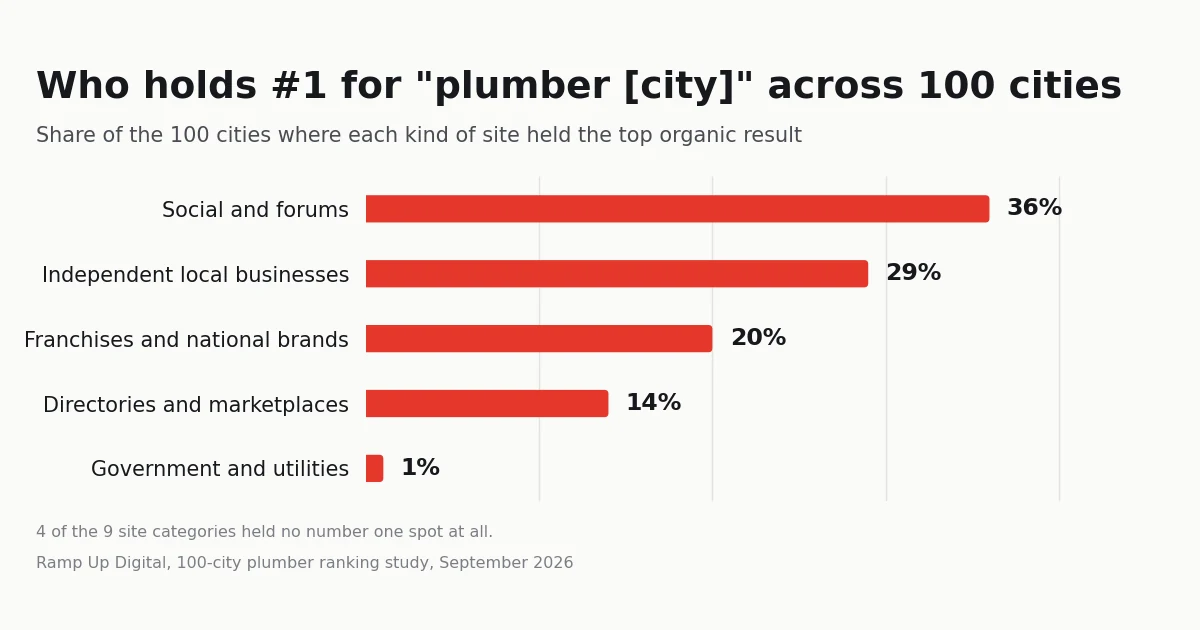
We parsed 880 ranking slots across 100 cities to see what really ranks for plumber searches. The page type, the template, the conversion layer, the gaps.
Sep 26, 2026|17 min read
Most advice gives you 16 ways to ask for reviews. The problem was never the ask. It's the system. Here's how local businesses build a review engine that runs every week.

Search "how to get more Google reviews" and you'll find articles promising 16, 18, even 25 "easy ways" to do it. Create a review link. Print a QR code. Send an email. Post on social.
Here's the truth after years of managing reviews for Bay Area service businesses (plumbers, movers, cleaners, tree services, restaurants): you already know you should ask for reviews. Knowing 18 ways to ask changes nothing. The business stuck at 23 reviews while its competitor sits at 400 doesn't have a knowledge problem. It has a system problem.
This guide is different. Instead of another wish list of tactics, it shows you how to build a review engine: a repeatable weekly system that decides who asks, when they ask, how they ask, and what happens after a review lands. It also covers the part most guides skip, the federal rules that now carry real financial penalties when you cut corners.
It's almost never dissatisfaction. It's friction plus forgetting. Happy customers fully intend to leave you a review. Then they get home, life happens, and the intention evaporates within hours.
We see the same three failure patterns in nearly every review audit we run:
The ask never happens. The owner asks when he remembers, which is when things are slow, which is when there are fewest customers to ask. Technicians and front-desk staff never ask, because nobody made it part of their job. One of our home-services clients found that their best technician, the one customers raved about by name, had never once asked for a review. Not out of reluctance. Nobody had ever asked him to.
The ask happens, but the path is broken. "Just look us up on Google!" isn't an ask. It's a scavenger hunt. The customer has to remember your exact business name, find the right listing among the lookalikes, locate the review button, and sign in. Every step loses people. If leaving a review takes more than two taps from a link you provided, most people quietly give up.
The ask happens too late. A review request three days after the job competes with everything else in the customer's inbox. The emotional peak is gone: the moment your crew finished the move without a scratch, the moment the leak stopped. Enthusiasm decays fast, and review conversion decays with it.
None of this gets fixed by learning a 17th way to ask. It gets fixed by a system.
Reviews are two things at once: your most important local ranking signal and your most-read marketing copy. That's why they deserve a system, not an afterthought. According to the Pew Research Center, 82% of American adults consult online ratings and reviews before buying something for the first time. For a local service business, "buying something for the first time" describes nearly every customer you'll ever win.
On the rankings side, reviews feed directly into the signals Google uses to order the local map pack. Review quantity, review recency, star rating, the keywords customers naturally use in review text, and whether the business responds: all of it shapes where you appear when someone searches "plumber near me." We covered the full ranking picture in our guide to how to rank on Google Maps. The short version: among businesses with equally well-optimized Google Business Profiles, the review profile is frequently the tiebreaker.
Reviews are also what Google's AI now reads on your behalf. AI Overviews and AI-assisted local results synthesize review sentiment into recommendations. "Customers praise their punctuality and fair pricing" is machine-written ad copy you cannot buy, only earn. A steady flow of detailed reviews is one of the strongest inputs you control.
There's a revenue effect that has nothing to do with rankings, too. When a homeowner compares three tree services at similar prices, the one with 300 recent, detailed, responded-to reviews wins the call, even if it ranks second. Reviews close the customers that rankings merely deliver.
Know the boundaries before you build, because as of late 2024, breaking them stopped being just a Google policy issue and became a federal one. The FTC's Rule on the Use of Consumer Reviews and Testimonials, in effect since October 21, 2024, prohibits buying fake reviews, paying for positive reviews, having employees or family post reviews without disclosure, and using intimidation to suppress negative ones. Violations can trigger civil penalties of tens of thousands of dollars per violation. Those cheap "reputation boost" services that sell review packages are now selling you federal liability.
Just as important: review gating is off the table. Gating is the practice of screening customers first ("How was your experience?") and sending only the happy ones to Google while diverting unhappy ones to a private form. Google has prohibited it for years, and cherry-picking only positive reviews now also runs afoul of FTC guidance. If your review software has a "filter unhappy customers" toggle, turn it off.
So what's allowed, and even encouraged? Google's own guidance in Google Business Profile Help tells businesses to remind customers to leave reviews and to share the direct review link. Asking isn't just legal, it's the officially recommended practice. Ask every customer. Ask in person. Ask by text or email. Make it as easy as you can. What you can't do: pay for reviews, trade discounts for reviews, ask only the happy customers, or dictate what the review should say.
The line is simple: influence how many people review you, never the content or the selection.
A review engine is a system that sends review requests every week without anyone having to remember, get motivated, or improvise. Here's how we build one:
Claim your direct review link and make it two taps. In your Google Business Profile dashboard, open "Ask for reviews" to grab your short review URL. Test it on a phone: it should open the review box in two taps. This link is the backbone of everything that follows.
Put the link in physical form. Turn it into a QR code and place it where the customer's moment of satisfaction happens: the invoice, the counter card, the fridge magnet the movers leave behind, the sticker on the furnace. A customer holding their phone at the moment of gratitude is your highest-converting audience.
Assign the ask to a person, per job. "Everyone should ask" means no one asks. The technician who finishes the job asks. The server who ran the table asks. The front desk asks at checkout. Write it into the job description and the closing checklist for every role that ends a customer interaction.
Script the ask so it names the person. "If you're happy with how today went, would you mind leaving us a Google review? It genuinely helps a small business like ours, and feel free to mention Marco was your technician." Reviews that name employees are more detailed, more credible, and hand you an internal scoreboard employees actually care about.
Follow up within 24 hours, once. Text the link the same day (text beats email for local services), while the experience is fresh. Send one polite reminder a few days later if nothing lands. Then stop. Pestering turns goodwill into annoyance.
Respond to every review, positive and negative. Response activity signals an engaged business to both Google and future customers, and visibly responding raises the odds the next customer bothers to write one, because people write more when they know someone reads it. Negative ones deserve special care. We wrote a full playbook on how to respond to negative Google reviews covering templates, removal rules, and the legal boundaries.
Review the scoreboard weekly. Five minutes in your Monday meeting: how many requests went out, how many reviews came in, who got named. What gets counted keeps happening. When the numbers dip, the system catches it instead of your memory.
Steps 1 and 2 take an afternoon. Steps 3 through 7 are habits, and they're the part that separates the 400-review business from the 23-review business.
The right way to ask depends entirely on your service model. A script that works in a customer's driveway falls flat at a checkout counter. Here's how the ask changes across the three most common local business models.
If you work at the customer's home or site (plumbers, movers, cleaners, tree crews, contractors), the ask belongs to the crew lead, in person, at the walkthrough. This is the moment the customer is most impressed and most grateful. The crew asks out loud, and the office texts the link within the hour, naming the crew. One of our moving-company clients turned the post-move walkthrough into a two-line ritual: confirm everything arrived intact, then make the ask. It became the single most reliable review source they have, because it's attached to a step that already happens on every job.
If customers come to you (restaurants, retail, salons, auto shops), the in-person ask is harder to personalize at volume, so let the environment do the asking. QR codes at the register and on receipts, a sign at the exit, and staff trained on a one-liner for regulars and obviously delighted customers. For restaurants especially, the receipt QR beats the follow-up email you'll never get an address for.
If you run a professional practice (dentists, optometrists, lawyers, accountants), discretion changes the etiquette. The ask should come from the front desk at checkout or in the follow-up message, framed around the practice rather than the specific service ("we'd be grateful if you shared your experience with the practice"). Healthcare providers, remember that patient privacy rules don't stop applying in review workflows. Never reference a patient's visit details in any public reply, and keep requests generic.
One more note, for the office manager or marketing coordinator who just got handed "fix our reviews" as a side project: your job isn't to ask customers yourself. Your job is to build steps 1 through 7 and get the owner to enforce step 3. A coordinator who chases reviews personally produces a trickle. One who installs a system produces a habit.
Ask within hours of the moment your customer felt the outcome, not days later when the invoice clears. Review willingness peaks with the emotional experience: the spotless house, the finished move, the tooth that stopped hurting. Every day between that peak and your ask costs you conversions.
Practical timing rules we hold clients to:
The other half of timing is cadence. A burst of 30 reviews in one week followed by six months of silence looks, to both Google and skeptical humans, like exactly what it usually is: a panicked campaign. A steady drip of reviews every week signals a business that's alive and consistently good. This is also why buying your way to a number fails before you even reach the legal risk. Velocity and recency matter, and they only come from a system that runs continuously.
Review software earns its cost only after the manual engine already works. Automation multiplies a system. It can't replace one. Tools in this category (Podium, Birdeye, NiceJob, and dozens of others) automate the request sequence: a job closes in your CRM or invoicing system, and a text with your review link goes out automatically.
When it makes sense: you complete many jobs per day, requests genuinely fall through the cracks at that volume, and you already know your ask converts. Automating the follow-up text from step 5 is the highest-value piece to hand a machine.
When it's overkill: you serve a handful of customers a day and the crew-lead ask already covers them. A $300-a-month tool that sends texts you could send from your existing invoicing app is margin lost for nothing. And no tool fixes a broken step 3. Software sends requests, but the in-person ask it amplifies still has to happen.
Whatever you adopt, avoid any feature marketed as "review filtering" or "sentiment routing" that sends only happy customers to Google. As covered above, gating violates Google policy and invites FTC scrutiny. The honest version, asking everyone and publicly answering whatever arrives, is also the version that builds a review profile readers actually trust.
Run the engine consistently and the compounding is visible by month six: a review count that climbs every month instead of every year, an average rating that reflects your real work, review text that mentions your services and your people by name, and a response under every single one. That profile does three jobs at once. It feeds the ranking signals in the map pack, it feeds the AI systems summarizing you to searchers, and it closes the customers who read reviews before calling, which, as Pew's research above shows, is most of them.
Perfection isn't the goal, for the record. A 4.8 with 350 reviews and thoughtful responses out-earns a suspicious 5.0 with 40. The occasional imperfect review, handled publicly and gracefully, is proof the rest are real. That's exactly why knowing how to respond to a negative review is part of the engine, not a separate crisis skill.
Reviews are also just one pillar of local visibility. They work alongside your profile optimization, citations, and website signals, the whole stack we build for clients through our Google Business Profile services and local SEO programs in San Mateo. If your profile fundamentals are shaky, fix those in parallel. Reviews amplify a strong foundation. They can't rescue a broken one.
You've got the full blueprint. Run the seven steps yourself, consistently, and it works. But consistency is the first thing that gets sacrificed in a busy season, and reviews are too important to run on leftover attention.
That's why review generation and response is a core part of what we do at Ramp Up Digital. Our review management service audits your current review profile against your local competitors, builds the request system around how your business actually operates, automates the follow-up sequence, and handles every response, including the negative ones, in your voice. It's one piece of the broader local visibility work our Bay Area SEO agency delivers for local service businesses every day.
Want to know why your competitor has 400 reviews and you don't? Contact Ramp Up Digital for a free review audit. We'll show you exactly where your review engine is leaking, and what it'll take to fix it.
Keep Reading

