Insights
SEO for Plumbers: What Actually Ranks in 100 Cities
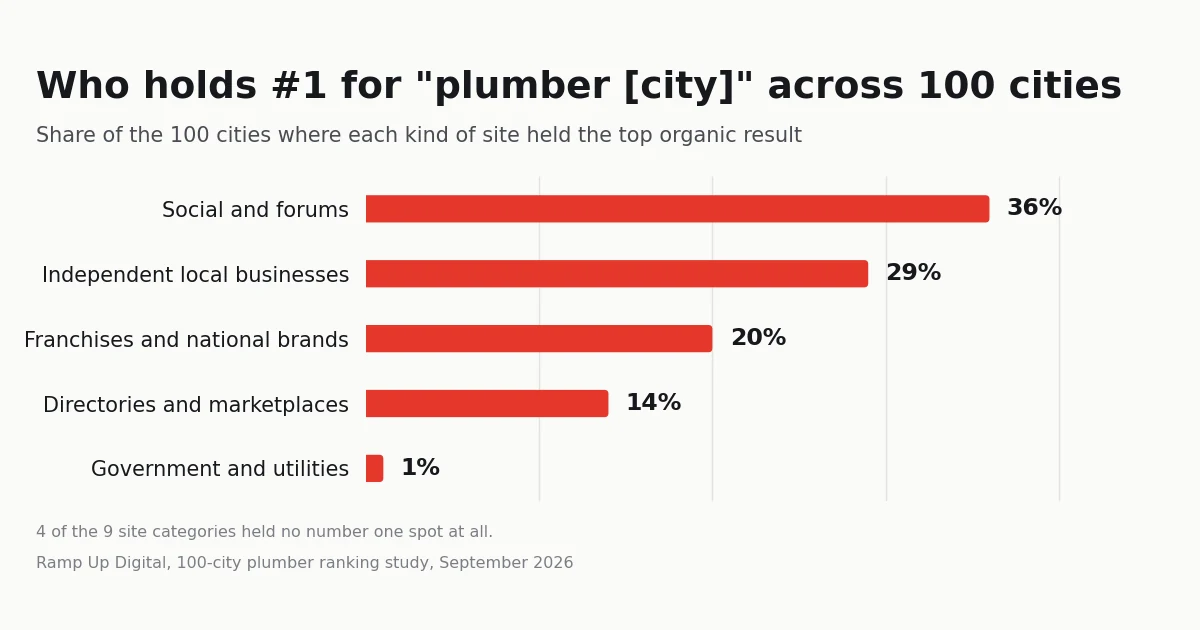
We parsed 880 ranking slots across 100 cities to see what really ranks for plumber searches. The page type, the template, the conversion layer, the gaps.
Sep 26, 2026|17 min read
14 auto repair shop marketing strategies, split into acquisition and retention, from an agency running real Bay Area accounts, including the oil change shop we took to the local 3-pack in 8 weeks.
The highest-leverage auto repair shop marketing strategies, in order: a fully optimized Google Business Profile, Google Local Services Ads, a review system that asks at the moment of checkout, and service pages built for the exact repair someone is searching for. Run that stack well and even an oil change shop with almost no online presence can reach the local 3-pack in about 8 weeks, which is the actual result we got for a San Carlos client with essentially no organic history to build on. That is not a hypothetical. It is the account we manage.
Most articles that show up when you search for auto repair shop marketing are written by software vendors selling you a platform, or by agencies that have never managed a shop's Google Business Profile through a slow February. I'm Jessie, the founder of Ramp Up Digital. I've spent more than a decade in SEO and web strategy, including in-house years at Intuit, Adobe, and Shutterfly, and today I run marketing for real Bay Area shops, oil change specialists and full-service repair operations both, spending real budget and watching the call tracking data every week.
One of those shops is Perfect Lube, an oil change shop in San Carlos that specializes in European and luxury vehicle maintenance. When we took over their marketing, they had almost no presence in Google's local map results for their core searches. Eight weeks later, they were in the local 3-pack. I'll walk through exactly what that stack looked like later in this post, because a checkable local ranking result is worth more than any traffic-percentage stat a vendor prints on their homepage.
This guide is organized the way your marketing decisions actually split: 8 acquisition strategies that bring new customers into your bays, and 6 retention strategies that bring the customers you already have back again. Whether you run a quick lube, a full-service repair shop, or a specialty maintenance operation, it covers the playbook end to end: what to spend, where to spend it, how to build the trust that gets the phone to ring, and the mistakes that keep bays empty. If you're a new shop with almost no reviews, the right starting half is different than if you're an established shop with a strong reputation and slowing growth. I'll flag exactly where that fork happens, because the generic "just do all of it" advice is how most shops waste their first year of marketing budget.
Auto repair shop marketing covers every channel that moves a car owner from "I need this fixed" to booked in your bay: your Google Business Profile, paid search, reviews, your website, retention messaging, and increasingly, AI-powered search results that summarize your reputation before a customer ever clicks through. It applies whether you're a quick lube changing oil in 20 minutes or a full-service shop rebuilding transmissions, though the tactics you lean on differ by which one you are. I'll fork that distinction throughout this guide rather than pretending both businesses need the same playbook.
The market context makes marketing matter more than it used to. The average vehicle on U.S. roads is now 12.8 years old, according to S&P Global Mobility's 2025 vehicle age report, the highest figure on record and still climbing. Older cars need more maintenance, which means more searches for the exact services you provide. But every shop within driving distance sees the same demand curve, which is exactly why the shops that market intelligently are booked out while the shops relying on word of mouth alone are watching bays sit empty on a Tuesday afternoon.
Here's the baseline math worth knowing before you set a budget. A customer who comes in for an oil change every six months at roughly $80 a visit is worth roughly $160 a year. Keep that customer for the 12.8-year average ownership window and oil changes alone are worth well over a thousand dollars in revenue, before a single brake job, fluid flush, or timing belt ever enters the picture. That context changes how you should think about spend: paying to acquire a customer worth that much isn't an expense, it's the best investment available to your business.
Budget 8 to 10 percent of gross revenue for shops under $500K annually, 5 to 8 percent for shops between $500K and $1.5M, and 3 to 6 percent above $1.5M, though absolute dollars keep climbing even as the percentage drops. If you're doing $400K a year, that's $2,700 to $3,300 a month across every channel. At $1M, it's $4,200 to $6,700.
| Annual Revenue | Recommended Marketing Budget |
|---|---|
| Under $500K | 8 to 10 percent of gross revenue |
| $500K to $1.5M | 5 to 8 percent of gross revenue |
| Above $1.5M | 3 to 6 percent of gross revenue |
For a shop spending $3,000 a month, here's a realistic split:
| Channel | Monthly Spend |
|---|---|
| Google Ads (Search + LSAs) | $1,500 to $1,800 |
| SEO and content | $600 to $800 |
| Review management and reputation tools | $100 to $200 |
| Email and SMS retention marketing | $100 to $150 |
| Website maintenance and hosting | $100 to $200 |
| Remaining | Reserve for seasonal campaigns, direct mail, or local sponsorships |
Here's the fork that actually matters, and it depends on where you're starting from, not your revenue. If you're a new shop or a shop with fewer than 30 Google reviews, put 70 percent or more of that budget into paid acquisition: Local Services Ads and Google Ads. You have no organic rankings and no review volume to lean on yet, so paid is the only lever that produces calls this month. Start with the acquisition half of this guide. If you're an established shop with 100 or more reviews and steady organic traffic, flip the ratio and shift budget toward the retention half, because you're already capturing new-customer demand and the bigger opportunity is squeezing more lifetime value out of customers you already have. Chasing the wrong side of that fork is the single most common budget mistake we see: new shops that spend on content that won't rank for a year, and established shops still paying full price for clicks their reviews and rankings should be earning for free.
If you run an oil change shop, lean your budget toward retention, because your business model depends on getting the same customer back every 3 to 6 months. If you run a full-service repair shop, lean toward acquisition, because each new customer represents a bigger single-visit return and you see them less often. That's the deciding factor, not your total budget size, and most generic marketing advice flattens this into one recommendation that fits neither business well.
Frequency and lifetime value. Oil change customers visit more often, every 3 to 6 months, but spend less per visit, $50 to $120. Full-service shops see customers less often but at higher ticket values, $250 to $650 per repair order. The oil change model depends on retention and frequency; the repair model depends on capturing the big-ticket jobs when they arise.
Keyword strategy. Oil change keywords are competitive per impression because more quick lubes chase a smaller keyword set, but CPCs tend to run lower since the service value is lower. Repair keywords cost more per click but carry higher conversion intent and ticket values. Oil change focus: "oil change near me," "synthetic oil change [city]," "[brand] oil change [city]" (BMW oil change San Carlos, for instance). Repair focus: "[specific service] [city]," "[symptom] repair near me," "check engine light [city]."
The upsell bridge. The smartest oil change shops treat the oil change as the acquisition tool and the complimentary multi-point inspection as the upsell bridge. Document what the vehicle needs during every visit, present findings with photos or a digital report, and a $79 oil change visit can convert into a $400-plus brake job or fluid flush appointment. That means your oil change ads can afford a lower cost-per-lead target, because the real revenue shows up during the inspection, not the oil change itself.
New shops, shops under 30 reviews, and shops in new markets start here. These eight strategies are ordered by leverage: the free assets first, then paid channels, then the positioning and partnership work that compounds on top.
Google Business Profile signals account for roughly a third of what determines your position in the local map pack, which makes it the single highest-leverage free asset available to any shop. Optimizing it costs nothing but time, and it's the first thing we fix on every account we take over.
Primary category selection. If you're primarily an oil change shop, your primary category should be Oil Change Service. If you're a general repair shop, use Auto Repair Shop. Then add every relevant secondary category: Brake Shop, Transmission Shop, Auto Air Conditioning Service, Auto Tune Up Service. Google uses these categories to decide which searches trigger your listing.
| Shop Type | Primary GBP Category | Secondary Categories to Add |
|---|---|---|
| Oil change shop | Oil Change Service | Brake Shop, Transmission Shop, Auto Air Conditioning Service, Auto Tune Up Service |
| General repair shop | Auto Repair Shop | Brake Shop, Transmission Shop, Auto Air Conditioning Service, Auto Tune Up Service |
Service listings with descriptions. Inside your GBP, add individual services, not just categories. Write a brief description for each that names the service and your city: "Full synthetic oil change for European and luxury vehicles in San Carlos" beats a bare "Oil Change" every time.
Weekly GBP posts. These function as free micro-advertisements. Post a seasonal tip, a completed job photo, or a current promotion every week. Shops that post consistently see higher engagement signals, and Google tracks those signals (views, clicks, calls, direction requests) as ranking inputs.
Photos. Upload at least 20 real photos: your bays, your team, your waiting area, and completed jobs. In the accounts we manage, listings with a current, real photo library consistently outperform listings running on a single five-year-old stock image on both direction requests and website clicks.
Picture a two-bay shop still running the same blurry storefront photo it uploaded in 2019. Adding 20 to 30 real photos, the lift, the team, a handful of finished brake jobs, costs nothing but an afternoon with a phone camera, and it gives Google, and the searcher who clicks into the listing before ever calling, something current to actually look at instead of a placeholder. That's the entire photo strategy: current, real, and refreshed a few times a year, not a one-time upload you forget about.
We covered the full step-by-step in our Google Business Profile optimization guide, and if you want the map pack ranking mechanics specifically, how to rank on Google Maps breaks down the rest of the local ranking factors this section doesn't have room for.
Reviews decide whether a stranger trusts your shop enough to hand over their car, and the data backs that up specifically for this industry. AAA's national driver trust survey found that two out of three U.S. drivers do not trust auto repair shops in general, and 73 percent of the drivers who distrust shops cite fear of being overcharged as the reason. That is the exact anxiety your reviews have to overcome before someone ever picks up the phone.
More broadly, BrightLocal's 2026 Local Consumer Review Survey found that 97 percent of consumers read reviews for local businesses, and 89 percent expect the business owner to respond to them. For an industry starting from two-thirds baseline distrust, a stack of recent, specific reviews with real owner responses is doing genuine trust-repair work, not just decorating your profile.
Target 8 to 15 new Google reviews a month. The shops we manage that hit this number consistently outrank competitors with a higher total review count but a stale profile, because Google weighs recency and velocity alongside volume.
The system that works: ask verbally at checkout, the moment of maximum customer satisfaction, then send a follow-up text within 30 minutes with a direct link to your Google review page. Respond to every review, positive and negative, within 48 hours.
Say a customer picks up their car after a $400 brake job. If your service advisor asks for a review right there at the counter, while the invoice matches what was quoted and the car is running quietly outside, that request lands during the exact window AAA's survey says drivers are most skeptical: the moment they find out what they owe. A follow-up text with a direct review link within 30 minutes catches the customers who say yes verbally but never pull out their phone on the spot. Our review management work for clients is built entirely around that timing, not around begging for stars after the fact, and we've published the full ask-system playbook in how to get more Google reviews.

LSAs appear above standard search ads carrying a Google Verified badge, which replaced the older Google Guaranteed badge, and you pay per lead instead of per click. For auto repair shops in competitive metro areas, LSA leads typically run $15 to $45 depending on the service type. LSAs combine top-of-page placement with a trust badge that reduces friction, which is why we prioritize LSA budget on every auto service account before Search is even funded.
Picture a shop turning on $1,500 a month in Local Services Ads for the first time. At $15 to $45 per lead, that budget alone produces somewhere between 33 and 100 leads a month before a single dollar goes toward standard Search campaigns, which is exactly why LSAs get first budget priority in every account we manage rather than an afterthought bolted on after Search is already funded.
Google Ads is the fastest path to phone calls for any auto service business, and the industry benchmarks are unusually favorable compared to most verticals. According to WordStream's 2026 Google Ads Benchmarks report, the Automotive: Repair, Service and Parts category averages a $4.35 cost per click, a 5.56 percent click-through rate, and a 15.51 percent conversion rate, against cross-industry averages of $5.42, 6.64 percent, and 8.18 percent. Auto repair converts nearly double the average industry, at a lower cost per click, which reflects the high intent behind searches like "brake repair near me" or "oil change open now." People searching for auto services need them now, not eventually.
| Metric | Auto Repair, Service and Parts | Cross-Industry Average |
|---|---|---|
| Cost per click | $4.35 | $5.42 |
| Click-through rate | 5.56% | 6.64% |
| Conversion rate | 15.51% | 8.18% |
Source: WordStream's 2026 Google Ads Benchmarks report.
Structure Search campaigns by service category once LSAs are running. Emergency and urgent services (overheating, check engine light, wouldn't start) carry the highest intent and justify the highest bids. Maintenance services (oil change, tire rotation, fluid flush) bring high volume at a lower ticket but are excellent for acquisition: the customer who books a $79 oil change and has a good experience is the customer who brings the same car back for a $900 brake job six months later. Repair services (brakes, transmission, engine) sit in between, with searchers who are often comparing shops, so your landing page and reviews have to close the deal.
Each service category should point to its own dedicated landing page. Never send paid traffic to your homepage. Matching the landing page to the search query can double your conversion rate on its own.
The keywords that convert: "[service] near me," "[service] [city]," "[service] open now," and "best [service] [city]." Exclude "DIY," "how to," "parts," "jobs," and "salary" as negatives, along with any car models that fall outside your service scope. Skipping negative keywords wastes 20 to 30 percent of a typical budget on clicks that were never going to book.
Budget $1,500 to $2,500 a month for most metro areas, which typically generates 40 to 80 leads depending on competition and service mix. Oil-change-only shops can often start lower, $800 to $1,200 a month, because the keyword set is narrower. Running the weekly search terms reviews, bid adjustments, and landing page tests this requires is a real workload, which is what professional PPC management exists to take off a shop owner's plate.
If Google Ads is the faucet you turn on for immediate leads, SEO is the well you dig for a permanent water supply. Every shop should invest here because organic traffic is free, compounds over time, and builds an asset you actually own instead of renting by the click.
The foundation is service-specific location pages. Every major service should have its own dedicated page: /oil-change-san-carlos, /brake-repair-san-carlos, /transmission-service-san-carlos, /check-engine-light-san-carlos. Each page needs the service and city in the title tag and H1, a genuine description of the service, approximate pricing or a price range, a time estimate, and a clear call to action. These pages do double duty: they rank organically and they serve as landing pages for the Google Ads campaigns above.
For a quick lube or oil change shop specifically, layer in "synthetic oil change [city]," "European car oil change [city]," and "oil change coupons [city]," plus the informational, high-volume "how often should I change my oil."
One piece of well-targeted content a month beats weekly filler. Seasonal maintenance guides ("Fall Car Care Checklist for Bay Area Drivers"), problem-based content ("Why Is My Car Shaking When I Brake?"), and cost guides ("How Much Does a Timing Belt Replacement Cost in Your County") all capture people at different points in the decision, and the same structured, clear-answer format that ranks organically increasingly feeds AI-powered search summaries too. If you're weighing whether this investment is worth it for a smaller shop, we answered that question directly in is SEO worth it for small businesses.
| Content Type | Example Title |
|---|---|
| Seasonal maintenance guide | "Fall Car Care Checklist for Bay Area Drivers" |
| Problem-based content | "Why Is My Car Shaking When I Brake?" |
| Cost guide | "How Much Does a Timing Belt Replacement Cost in Your County" |
Specialization positioning is one of the most underused levers in this industry. Market yourself as a generalist ("We fix all cars!") and you compete with every shop, dealership, and quick lube in your area on price alone. Position around a specialty and you narrow the competitive field to the handful of shops that can credibly claim it.
Perfect Lube's specialization around luxury vehicle oil changes, covered in detail below, is the clearest example we manage: it commands higher prices because BMW, Mercedes, Audi, and Porsche owners expect to pay more for a shop that clearly understands their vehicle, it narrows the competitive set away from Jiffy Lube and every generalist nearby, and it attracts customers who tend to be more consistent about maintenance schedules and more loyal once they trust a shop.
Even a general repair shop can carve out a specialty: "the Bay Area's go-to shop for Toyota and Honda maintenance," or "specializing in high-mileage vehicles over 100,000 miles." The specificity is the strategy, not the size of the niche. If you want to see how we've approached differentiated positioning for other Bay Area service businesses, our portfolio has more examples.
Your website exists to do one thing: convert visitors into phone calls or form submissions. Here's what a high-converting shop site needs in 2026.
Phone number in the header, clickable on mobile. Over 60 percent of your visitors are on phones. If they have to hunt for your number, they call the next shop in the results.
Page speed under 3 seconds. Google penalizes slow sites in rankings, and users bounce. A 5-plus second load loses 30 to 40 percent of visitors before they read a word.
Custom-built beats templated. Off-the-shelf auto repair templates tend to look generic and load slowly because they're bloated with page-builder code nobody trimmed. A site built for your shop specifically outperforms a template on both search rankings and how many visitors actually pick up the phone, because the pages can be built around your real specialty and service area instead of the same boilerplate every competitor on the same template is running too.
Trust signals on every page. ASE certifications, manufacturer logos for the parts and oils you use, your review count and rating, years in business, and before-and-after photos.
Online scheduling or a quote form. Not every customer wants to call. A short form capturing name, phone, vehicle year and make and model, and service needed reaches the customer planning tomorrow's service at 2 a.m.
Schema markup. Add LocalBusiness and AutoRepair structured data so Google can surface your hours, address, rating, and price range directly in search results.
Google should be the majority of your budget, but the channels outside of Google consistently produce leads for the shops we manage for one shared reason: they borrow trust from a neighbor instead of a stranger's algorithm.
Nextdoor is unusually strong for auto repair in the Bay Area specifically, because homeowners post asking for a trusted mechanic recommendation constantly, and the responses come from actual neighbors instead of anonymous reviewers online. Claim your business page, respond helpfully to posts asking for recommendations without turning it into a pitch, and make it easy for satisfied customers to mention you there.
Say a customer's neighbor asks on Nextdoor for a mechanic who won't push unnecessary work. If your last several interactions on that platform were genuinely helpful rather than salesy, you're the name that gets tagged in the replies, and that lead walks in already trusting you more than anyone they found cold on Google.
Referral programs don't need to be complicated. Offer a $20 to $30 credit for any referral that books a service, and mention it in three places: your post-visit follow-up text, a card handed over at checkout, and your website. A referred customer already trusts you before the first call, and the cost is a credit you only pay when the job actually books.
Partner with adjacent local businesses. The businesses your customers already visit are a referral channel most shops never activate. A body shop that doesn't do mechanical work, a tire store that doesn't do engine diagnostics, a car wash or detailer down the street, a used car dealer who needs pre-sale inspections: each one regularly meets car owners who need exactly what you do. Set up a simple two-way arrangement: you send them your overflow and out-of-scope work, they send you theirs, and both businesses put a stack of the other's cards at the counter. The best versions are specific ("we send all our transmission diagnostics to them, they send us all their oil and brake work"), because vague "we'll refer each other" handshakes evaporate within a month.
Local sponsorships are hard to attribute directly, but they compound two ways: local brand recognition, and often a backlink from the organization's website, something no Google Ads campaign can produce. Sponsoring a Little League team or a community event in your city is a small, steady investment that a pure-digital budget skips entirely.
Direct mail still has a place. Oil change reminder postcards mailed 90 days after the last visit, with a small discount, catch customers who don't open texts or emails. New mover mailers through USPS Every Door Direct Mail, targeted at specific carrier routes for around $0.20 a piece, reach people who need a new mechanic the moment they arrive. Commit to at least three mailings before judging results. A single postcard is easy to ignore; the third one sticks.
Perfect Lube is an oil change shop in San Carlos, California that specializes in European and luxury vehicle maintenance, and when we took over their marketing, they had no meaningful presence in Google's local map results for their core searches. Eight weeks later, they were in the local 3-pack. Here's what that stack actually involved, because most "we got great results" claims in this industry come with zero detail on the mechanics.
We rebuilt their Google Business Profile from a thin, generic listing into one with the correct primary category (Oil Change Service), a full set of secondary categories, service listings written for their actual specialty (European and luxury vehicle oil changes, not a generic "oil change"), and a current photo library of the shop, the bays, and completed work. We stood up a review request system that asks at checkout and follows up by text within 30 minutes. And we built their site around the real differentiator: they were never trying to be the cheapest oil change in San Mateo County, they're the shop that understands a BMW or a Porsche, so the site carries navy and gold branding that matches that premium positioning instead of looking like every other quick lube page. None of that is exotic. It's strategies 1, 2, 6, and 7 from the acquisition list above, run in the correct order, for a shop that had almost nothing built yet.
One honest caveat: eight weeks is fast, and it worked partly because Perfect Lube had almost no conflicting signals to untangle. No old NAP inconsistencies, no abandoned duplicate listings fighting the new one. A shop carrying years of citation clutter should expect a longer runway. You can search their core service and city right now and see where the profile stands. That's the same test I'd apply to anyone selling you results: ask for one query you can check yourself. If you run a shop in San Carlos specifically, our San Carlos SEO page has more detail on how we approach that exact market.
Acquiring a new customer costs roughly five times more than retaining an existing one, and yet most auto repair and oil change shops run zero proactive retention marketing. The customer drives away and the shop just hopes they come back on their own. Established shops with 100-plus reviews and steady organic traffic should weight budget here first, and oil change shops live or die on this half of the playbook regardless of size, because the whole model depends on the same customer returning every 3 to 6 months.
The highest-margin marketing list you own is sitting in your shop management system right now: every customer who heard "your rear brake pads are at 3 millimeters" and said "not today." They didn't say no. They said not yet, and then nobody ever contacted them again.
Work the list systematically. During every multi-point inspection, document declined and deferred work with photos, not just line items, because "rear pads at 3mm, photo attached" is persuasive in a way an invoice line never is. Then follow up on a schedule matched to urgency: a brake or safety item gets a text at 30 days, a fluid service or belt gets 60 to 90 days, and a cosmetic or comfort item can ride until the next visit. The message is short and specific: the vehicle, the finding, the photo, and a one-tap way to book.
The math is hard to beat. A shop writing $30,000 a month in estimates with a typical decline rate is leaving five figures of already-diagnosed work on the table every month, and the customer already trusts you enough to have been in your bays. Recovering even 15 to 20 percent of declined work usually outproduces an entire month of cold advertising spend, at essentially zero marketing cost.
Trigger an automated text based on time since last service: 4 months for conventional oil, 5 to 6 months for synthetic. Include the customer's name, a booking link, and your number. For an oil change shop this single automation is the closest thing to a revenue dial the business has: the service interval is predictable, the customer already chose you once, and the text arrives exactly when the windshield sticker starts nagging them.
One compliance step before any of this works: register your business for 10DLC (10-digit long code), the carrier registration system for businesses texting from regular phone numbers in the U.S. Unregistered business texting gets filtered or blocked by carriers, which is why some shops swear SMS "doesn't work" while their reminders sit undelivered. Your texting or shop management platform handles the registration paperwork, it typically costs a few dollars a month, and it's the difference between 95 percent deliverability and shouting into a void. Register first, then automate.
Four times a year, tied to real seasonal needs: spring (AC, alignment after potholes), summer (coolant, tire pressure), fall (brakes, battery, wipers), winter (battery, heating, tread). Each email is one seasonal risk, one clear recommendation, and one booking link, not a newsletter. The open rates on a well-timed "Bay Area rainy season is coming, when did you last replace your wipers and check your tread?" email embarrass every generic promo blast, because it reads like a mechanic's reminder instead of marketing.
Within 48 hours of a new customer's first visit, send a thank-you with a review request and a modest discount on their next service. This does two things at once: it generates the review, and it creates the reason for a second visit, which is the visit that turns a one-time customer into a regular. First-visit customers are the leakiest point in the whole funnel: they had a fine experience, they'd probably come back, and they'll still drift to whoever is closest next time unless you give them a concrete reason to return to you specifically.
For high-frequency businesses like oil change shops: buy 5, get the 6th at 50 percent off or free, tracked digitally. If your average oil change runs $80, giving away $40 to $80 on visit six locks in $400-plus in revenue from the first five, which is a customer acquisition cost of $40 to $80 for someone who has already proven they'll return. Full-service shops can run the same logic on a points basis (a percentage of every repair order banked as credit), which quietly raises the switching cost of trying the shop across town.
Every channel a customer can use to contact you is a retention tool, because the shop that's easiest to reach is the shop that keeps the relationship. Turn on online scheduling so the customer planning tomorrow's oil change at 2 a.m. can book it then. Enable messaging on your Google Business Profile and actually answer it. Let customers text your business line with a photo of a dashboard warning light and get a human reply. None of this replaces the phone; it catches everyone who wasn't going to call in the first place. The shops that respond to a texted question in ten minutes are building the kind of habit-level loyalty that no coupon matches.
Running two or more shops changes the mechanics of everything above, because Google treats every location as its own competitor in its own map pack. The multi-location version of this playbook:
Not every channel is worth your time. Here's what wastes budget for auto repair and oil change shops based on what we see across managed accounts.
Cold social media advertising. Running Facebook or Instagram ads to people who aren't actively looking for auto service produces expensive, low-quality leads. The intent isn't there. Retargeting is the exception: showing ads to people who already visited your site performs reasonably well, because you're reminding an interested visitor, not interrupting a stranger.
Coupon books and local magazines. Response rates have cratered. In most markets, cost per lead from print coupon books runs 3 to 5 times higher than Google Ads. Small towns with limited digital competition are the rare exception.
SEO gimmicks. Keyword stuffing, link farm backlinks, or "guaranteed number one ranking" services either do nothing or actively harm your rankings once Google catches on, and it does catch on. Real SEO takes 3 to 6 months to show results. There are no shortcuts.
Groupon and deep-discount deal sites. These attract price-sensitive one-time visitors, not loyal customers. The average deal-site customer has no brand loyalty and won't return at full price, so you end up doing discounted work for people who never come back.
Over-investing in content before the fundamentals are set. Spending hours on video or social content while your GBP sits unoptimized and you're carrying 23 Google reviews is backwards. Get the fundamentals right first. Content is a multiplier, not a foundation.
If you can't measure it, you can't improve it. Every dollar you spend should be traceable to a result. At minimum: call tracking numbers on your website and Google Ads, GBP Insights for calls and direction requests and website clicks from your listing, Google Analytics for form submissions and click-to-call events, and a simple CRM or spreadsheet recording how each new customer found you.
When your cost per new customer sits well below what that customer is worth over the ownership window covered earlier in this post, the math isn't debatable. The shops that track these numbers grow. The shops that guess stagnate.
If you're starting from zero or resetting your marketing strategy entirely, here's the priority order:
By day 90 you should have a measurable acquisition engine, an organic presence building momentum, and a retention system keeping past customers coming back.
What is the best marketing strategy for an auto repair shop? Start with the channels where demand already exists: a fully optimized Google Business Profile and Local Services Ads, backed by a review system that asks at checkout. That combination produces calls the fastest because it meets people who are already searching. Add service-specific SEO pages and retention marketing (SMS reminders, email, referrals) once the acquisition engine is running, since those compound over time rather than paying off immediately.
How much should an auto repair shop spend on marketing? Budget 8 to 10 percent of gross revenue if you're under $500K annually, 5 to 8 percent between $500K and $1.5M, and 3 to 6 percent above that. New shops or shops under 30 reviews should weight that budget heavily toward paid acquisition; established shops with 100-plus reviews get more value shifting toward retention and content.
How do you market a multi-location auto repair shop? Treat every location as its own shop: a fully built Google Business Profile per address, a dedicated location page per store on your site, per-store review velocity targets, and separate call tracking so you can see which location is underperforming. New locations start on the acquisition side of the budget fork even when the brand is established, because map pack rankings and review volume don't transfer between addresses.
Do Nextdoor and referral programs actually work for auto repair shops? Yes, particularly in dense Bay Area neighborhoods where Nextdoor recommendation threads are active and frequent. Both channels work for the same reason: the lead arrives pre-trusted because it came from a neighbor or a past customer rather than a cold search result, which typically means a shorter sales cycle and a lower cost per booked job than most paid channels.
Is local SEO or Google Ads better for a new auto repair shop? Google Ads and Local Services Ads first, because a brand new shop has no organic rankings yet and needs calls this month. Local SEO takes 3 to 6 months to show results, so start it in parallel but don't expect it to carry the business in year one. Once your service pages start ranking, you can shift budget away from paid and let organic traffic do more of the work.
Marketing an auto repair or oil change shop isn't complicated, but it takes discipline, measurement, and a willingness to invest where the data says to invest. The shops that dominate their local market in 2026 aren't doing anything exotic. They're executing the fundamentals from both halves of this playbook with consistency:
Nail those six and the near-term outcome is simple: your phone rings more this month than last month. The long-term outcome is the one that actually matters: a shop that isn't renting every customer from Google at full price, because reviews, rankings, and repeat visits are doing an increasing share of the work for free.
We're Ramp Up Digital, a digital marketing agency serving the Bay Area from San Mateo County, working exclusively with local service businesses, including oil change and auto repair shops. We build the exact stack in this post: Google Business Profile, Local Services Ads, review systems, service pages, and retention marketing, and we know what works because we watch the data every day, not because we read it in someone else's case study.
If you're ready to stop guessing and start growing, get in touch with us today. We'll audit your current marketing presence, show you exactly where the opportunities are, and build a plan tailored to your shop, your budget, and your goals. No obligation, no generic pitch deck, just a conversation about what it takes to fill your bays.
Keep Reading

