Insights
SEO for Plumbers: What Actually Ranks in 100 Cities
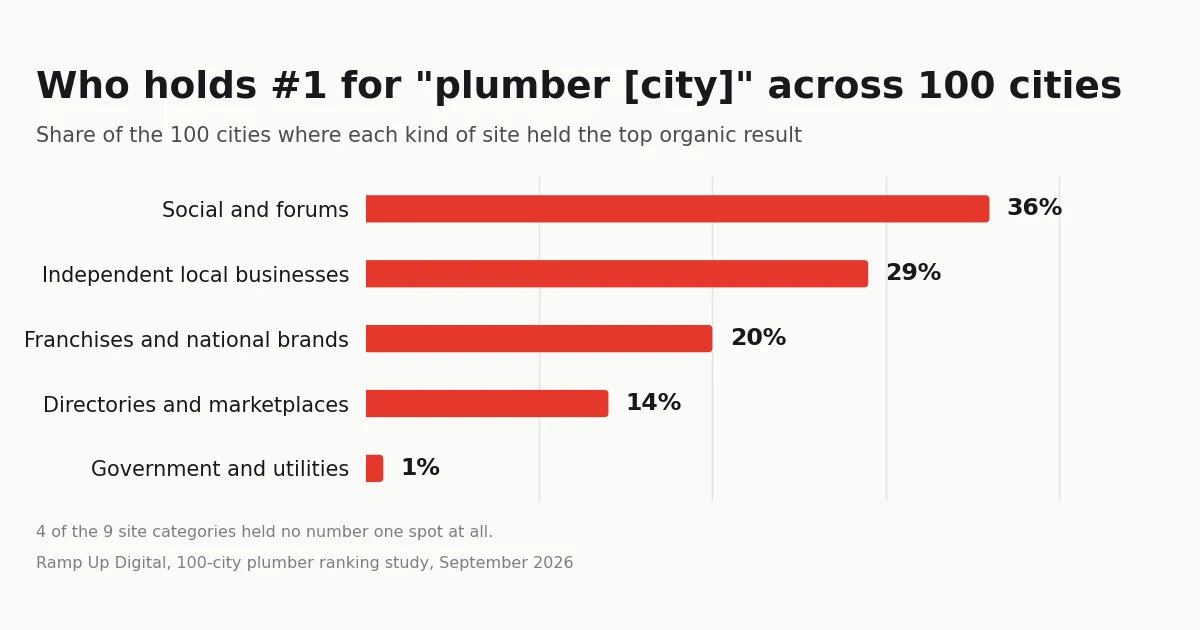
We parsed 880 ranking slots across 100 cities to see what really ranks for plumber searches. The page type, the template, the conversion layer, the gaps.
Sep 26, 2026|17 min read

Local SEO for plumbers comes down to winning three surfaces: the Google Maps 3-pack (driven by your Google Business Profile, reviews, and proximity), AI Overviews (driven by structured, original content Google's AI can cite), and organic results (driven by dedicated service and city pages). Nail all three and the emergency calls come to you. Ignore any one of them and a competitor picks up the phone instead.
When a homeowner's pipe bursts at 2 AM, they grab their phone and search "emergency plumber near me." Where your business appears in that moment (Google Maps, AI Overviews, or organic results) determines whether you get the call or your competitor does.
We manage local SEO for plumbing companies across multiple markets, and the landscape has shifted dramatically in the past year. Google's AI Overviews now appear on the majority of local service queries, the Local Pack algorithm has been updated to weigh review signals differently, and the old playbook of "claim your listing and wait" no longer cuts it.
This guide covers what is actually working right now for plumbers who want to dominate local search in 2026, not generic advice recycled from 2021, but the specific strategies we are executing for plumbing clients today.
Local search for plumbers is no longer a single ranking game. There are now three distinct surfaces where your business needs to show up, and most plumbers are only thinking about one of them.
This is the one everyone knows. The three-pack of local business listings that appears at the top of search results for queries like "plumber near me" or "drain cleaning San Mateo." Proximity, reviews, and Google Business Profile optimization are the primary drivers here. This is still the highest-converting real estate in local search: a Maps listing with strong reviews and a click-to-call button converts at extraordinary rates.
More and more local plumbing queries now trigger AI Overviews: the AI-generated summary boxes that appear above or alongside traditional search results. When someone searches "how much does sewer line repair cost" or "signs of a slab leak," Google increasingly generates an AI answer rather than just listing blue links.
This changes the game fundamentally. AI Overviews do not rank websites. They cite them. Google's AI pulls from sources it considers authoritative, specific, and well-structured. If your website has detailed, original content about plumbing services and costs in your market, you have a chance to be cited. If you have a generic services page, you are invisible to AI search.
Traditional organic listings still matter, especially for service-specific and location-specific queries. "Water heater installation in [city]" and "sewer line repair cost [city]" are the kinds of queries where a well-optimized service page can rank and convert. These searches show strong commercial intent, and a page that ranks organically for them generates leads month after month without ongoing ad spend.
Most plumbers focus exclusively on Maps. The companies winning in 2026 are visible across all three surfaces. For a broader look at how AI is reshaping local search, read our guide on AI Overviews and what they mean for local businesses.
Google's local algorithm weighs three primary factors for Maps rankings. Understanding which ones you can and cannot control is essential to focusing your efforts where they actually matter.
How close your business is to the searcher. You cannot change this. If your office is in San Carlos and the customer is in Redwood City, a Redwood City plumber will have a proximity advantage. This is why service area coverage and multi-location strategies matter, but gaming proximity with fake addresses is a violation of Google's guidelines and will get your listing suspended.
How well your Google Business Profile matches the search query. This is where your GBP categories, service descriptions, and website content come into play. A plumber whose profile explicitly lists "sewer line repair" as a service with a detailed description will rank higher for "sewer line repair near me" than a plumber whose profile just says "Plumber."
How well-known and trusted your business is online. This is measured through reviews, citations, backlinks, and overall web presence. A plumber with 200 Google reviews and consistent listings across major directories will outrank a plumber with 15 reviews and no citations, even if the second plumber is closer to the searcher.
Focus your effort on relevance and prominence. These are the factors you can directly influence, and they are where the ROI lives. For a detailed breakdown of Maps ranking strategies, see our complete guide on how to rank in Google Maps.
Your Google Business Profile is the single most important asset in your local SEO strategy. Most plumber GBP listings are set up once and never touched again. That is a mistake, and an opportunity for you.
Google uses secondary categories to determine relevance for specific queries. A plumber who has added "Water Heater Installation Service" as a secondary category will rank better for water heater queries than one who has not. This takes 30 seconds to set up and directly impacts visibility.
Add every service you offer with a detailed description for each one. Do not just list "Drain Cleaning." Write: "Professional drain cleaning for kitchen sinks, bathroom drains, floor drains, and main sewer lines. We use hydro jetting and mechanical snaking to clear stubborn clogs. Same-day service available."
Google reads these descriptions and matches them against search queries. More detail means more relevance signals.
Post to your GBP weekly. Share seasonal tips, completed job photos (with customer permission), special offers, and service spotlights. Consistent posting signals to Google that your business is active and engaged. It also gives potential customers more content to evaluate when they find your listing.
Respond to every single review within 24 hours. Positive reviews get a genuine thank-you. Negative reviews get a professional, empathetic response that moves the conversation offline. Google has confirmed that review responses are a factor in local rankings, and they are a massive trust signal for potential customers reading your reviews.
For more GBP optimization tactics, see our Google Business Profile tips guide.
This is the biggest shift in local search since the introduction of the Local Pack, and most plumbers have no strategy for it.
A growing share of plumbing questions now get an AI Overview answer. When a homeowner searches "how much does it cost to replace a water heater in San Mateo" or "what causes low water pressure in an old house," Google generates an AI-curated answer at the top of the results page. That answer cites sources, and being one of those cited sources is the new SEO battleground.
AI Overviews do not rank pages the way traditional search does. They look for:
You need to create content that directly answers the questions homeowners are typing into Google. Not blog posts about "5 Tips for Maintaining Your Pipes." Those attract DIYers, not paying customers. Instead:
This content serves double duty: it ranks organically for long-tail keywords AND it feeds Google's AI the specific, authoritative information it needs to cite your business in AI Overviews.
Citation building used to mean submitting your business to as many online directories as possible. Plumbing companies would list themselves on 300 to 500 directories and hope the volume would boost their rankings.
That approach is outdated. In 2026, citation quality matters far more than citation quantity. You do not need 500 directory listings. You need perfect consistency across the directories that actually matter.
Your name, address, and phone number (NAP) must be identical (down to the abbreviation) across these platforms:
"ABC Plumbing" and "ABC Plumbing Inc." are not consistent. "123 Main St" and "123 Main Street" are not consistent. "(650) 555-1234" and "650-555-1234" are not consistent. Google uses NAP consistency across the web to validate your business information. Inconsistencies introduce doubt, and doubt suppresses rankings.
Audit your citations quarterly. Search your business name, phone number, and address individually. Find every listing. Fix every discrepancy. This is unglamorous work, but it directly impacts your local SEO performance.
Not all content is created equal for plumbing SEO. The wrong content attracts the wrong audience. The right content attracts homeowners who are ready to pick up the phone.
For a deeper dive into plumbing SEO content strategy, check out our SEO guide for plumbers.
If you are starting from scratch or resetting your local SEO strategy, here is a week-by-week action plan that covers the highest-impact activities first.
You will not rank #1 in the Maps pack after 30 days. Local SEO is a compounding investment. But after the first month, you should see:
Track these metrics monthly. After 90 days, you should see meaningful movement in Maps rankings and organic visibility. After 6 months, you should be generating measurable leads directly attributable to local SEO.
Local SEO for plumbers is not a one-time project. It is an ongoing engine that compounds over time. Every review you earn, every service page you publish, every citation you fix: these accumulate into a web presence that becomes harder and harder for competitors to match.
The plumbing companies that dominate local search in their markets are not doing anything revolutionary. They are doing the fundamentals consistently:
The companies that start this work now will have a compounding advantage over competitors who wait. Local SEO rewards consistency and early action. Every month you delay is a month your competitors are building signals you will eventually have to overcome.
If you want to understand how these local SEO strategies connect to broader search visibility, explore our SEO services for Bay Area businesses.
Ready to dominate local search in your plumbing market? Contact Ramp Up Digital for a free local SEO assessment. We will audit your Google Business Profile, review your citations, analyze your competitors, and show you exactly where the opportunities are.
Keep Reading

