Insights
SEO for Plumbers: What Actually Ranks in 100 Cities
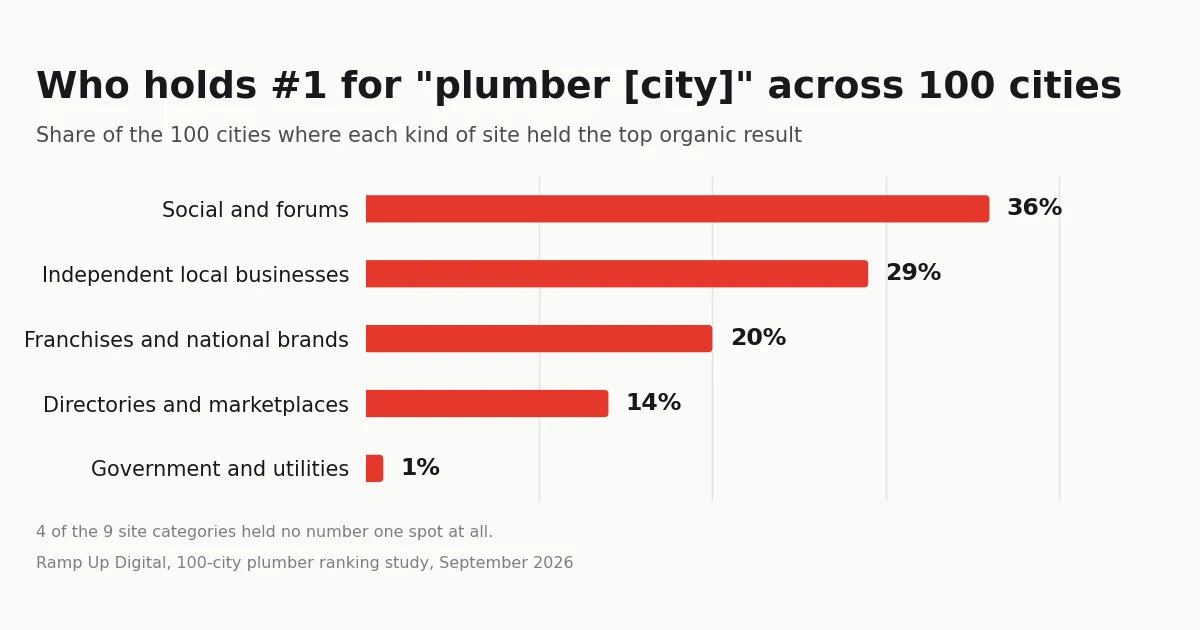
We parsed 880 ranking slots across 100 cities to see what really ranks for plumber searches. The page type, the template, the conversion layer, the gaps.
Sep 26, 2026|17 min read

We have audited dozens of plumber websites. The pattern is always the same: the site looks decent, but the phone does not ring. Here is why, and exactly how to fix it.
Most plumbing companies invest in a website because they know they need one. Someone builds it, adds a logo, lists the services, drops in a stock photo of a wrench, and calls it done. The site sits there looking perfectly fine while competitors with uglier websites generate three times the leads.
The problem is never aesthetics. The problem is conversion architecture. A plumber website that does not convert is not a website. It is an expensive digital business card that nobody asked for. We have rebuilt plumbing websites across the Bay Area and beyond, and the fixes are almost always the same. Here is what we find and what we change.
After auditing plumbing sites across dozens of markets, we see the same five problems destroying lead generation over and over again.
More than 60% of plumbing searches happen on mobile devices. A homeowner with a burst pipe at midnight is not going to scroll through your "About Us" page looking for a phone number. They need a tap-to-call button visible the instant the page loads: no scrolling, no hunting, no friction.
We consistently see plumber websites that bury the phone number in the footer or hide it behind a hamburger menu. Every extra tap between the customer and your phone line is a lost lead. The phone number should be:
53% of mobile users abandon a site that takes longer than 3 seconds to load. Plumbing customers in an emergency will not wait. They will hit the back button and call the next result on Google.
Most plumber websites we audit load in 5 to 8 seconds on mobile. That is an eternity when someone's basement is flooding. Speed is not a nice-to-have. It is the difference between getting the call and losing it.
This is one of the most common and most costly mistakes. A single "Services" page that lists drain cleaning, water heater installation, sewer repair, leak detection, and bathroom remodeling in one long bulleted list is an SEO disaster.
Each service needs its own dedicated page. A single services page means you are competing for exactly zero specific keywords. Google cannot rank one page for "drain cleaning in San Jose" AND "water heater installation in San Jose" AND "sewer line repair in San Jose." You need individual pages targeting individual services in individual locations.
When a homeowner is choosing between three plumbers, reviews are the deciding factor. Social proof is everything in home services. If your website does not prominently display Google reviews, service guarantees, licensing information, and insurance badges, you are asking customers to trust you blindly.
We see plumber websites with zero reviews displayed on the homepage. Meanwhile, the plumber ranking below them has 15 five-star reviews embedded right beneath the hero section. Guess who gets the call.
Every additional form field reduces conversions. We have seen plumbing contact forms asking for full address, preferred appointment time, how they heard about the company, and a detailed description of the problem, before the customer has even decided to hire anyone.
Your contact form needs three fields: name, phone number, and a brief problem description. That is it. You can gather the rest on the phone. The goal of the form is to start a conversation, not to collect a customer dossier.
We recently rebuilt a Bay Area plumbing company's website. Before the rebuild: 2 leads per week. After: 8 to 10 leads per week. Same company, same service area, same team. The only thing that changed was the website.
Here is what we changed and why each element matters:
You can see examples of this approach in action on our portfolio page. The results speak for themselves.
This is where most plumber websites leave the biggest opportunity on the table. Each service your company offers needs its own dedicated page, and each page needs to be built for both search engines and real customers.
Title format: "[Service] in [City]: [Company Name]"
For example: "Drain Cleaning in San Mateo: ABC Plumbing" or "Water Heater Installation in Redwood City: ABC Plumbing."
Every service page should answer these questions:
Implement LocalBusiness and Service schema markup on every service page. This structured data helps Google understand exactly what services you offer, where you offer them, and what customers say about them. It also increases your chances of appearing in rich results and AI-generated answers.
If your current site does not have schema markup, you are invisible to the structured data signals that increasingly determine search visibility. For more on how to build service pages that rank, check out our SEO guide for plumbers.
More than 70% of plumbing searches happen on mobile devices. And unlike someone casually browsing for a new restaurant, plumbing searches are often urgent. A homeowner standing in two inches of water is searching on their phone, stressed, and ready to call the first plumber who makes it easy.
Your mobile site needs to deliver on four non-negotiable requirements:
We build our plumber client websites with a mobile-first approach because that is where the leads come from. If you are evaluating your current site, pull it up on your phone right now and try to request service. If it takes more than 10 seconds or more than 2 taps to reach a human, your site is costing you money.
Website speed is not a vanity metric for plumbers. Every additional second of page load time reduces conversions by approximately 7%. A site that loads in 5 seconds instead of 2 seconds is losing roughly 20% of potential leads before they ever see your content.
Go to Google PageSpeed Insights and enter your website URL. If your mobile score is below 50, you have a serious speed problem. If it is below 30, your site is actively repelling customers.
Speed optimization is one of the highest-ROI improvements you can make to a plumber website. It costs relatively little and directly increases the number of visitors who stick around long enough to call.
This is the question we get from almost every plumbing company that contacts us. The answer depends on what you are starting with.
We typically rebuild plumber websites on modern frameworks that score 95+ on Google Lighthouse performance audits. The result is a site that loads in under 2 seconds, ranks for targeted service keywords, and converts visitors into calls at 3 to 5 times the rate of the old site. You can learn more about our approach on our web development services page.
A plumber website is not a brochure. It is a lead generation machine, or at least it should be. Every element on every page should exist for one reason: to get a qualified homeowner to pick up the phone or fill out a form.
The plumbing companies that dominate their local markets are not the ones with the fanciest websites. They are the ones with websites engineered for conversion: fast loading, mobile-optimized, service-specific, trust-building, and frictionless.
If your website looks fine but is not generating calls, the fixes we have outlined here will change that. But execution matters as much as strategy. A click-to-call button in the wrong place, a service page with thin content, or a mobile experience that is 90% there but not quite right: these details are the difference between 2 leads per week and 10.
Pair a high-converting website with a strong local SEO strategy and your plumbing company will have a reliable, measurable pipeline of new customers coming in every single month.
Ready to turn your plumber website into a lead machine? Contact Ramp Up Digital for a free website audit. We will show you exactly what is costing you leads and how to fix it.
Keep Reading

