Insights
SEO for Plumbers: What Actually Ranks in 100 Cities
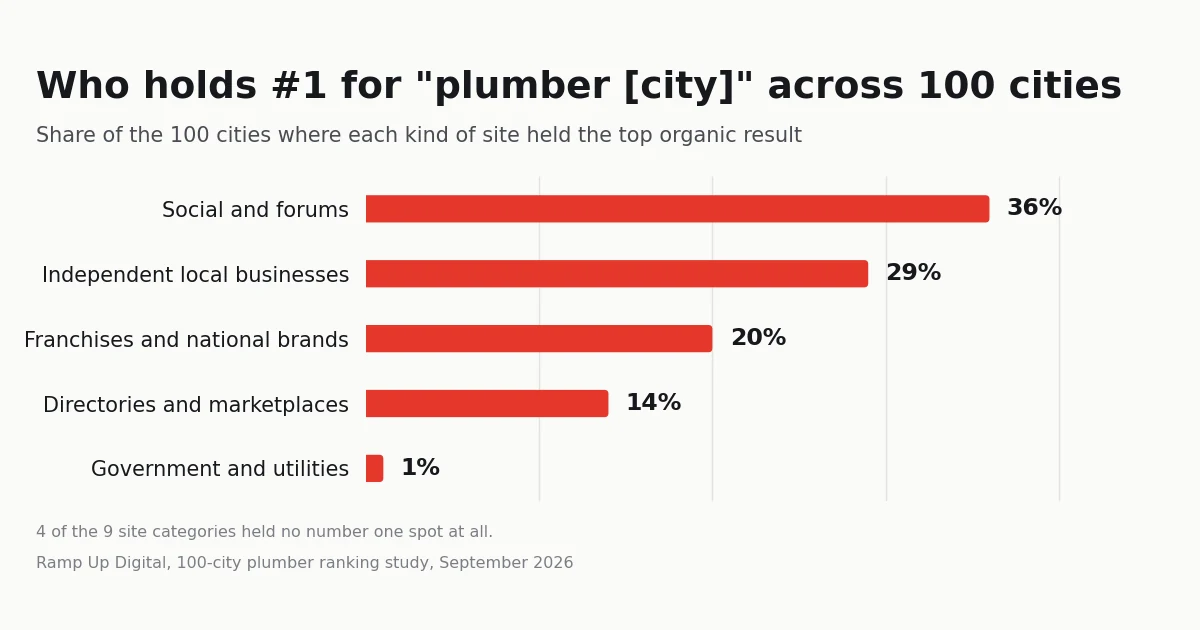
We parsed 880 ranking slots across 100 cities to see what really ranks for plumber searches. The page type, the template, the conversion layer, the gaps.
Sep 26, 2026|17 min read
Everything we run for a real tree service client, with actual cost-per-lead data, seasonal budget strategies, and the channels that fill the schedule versus the ones that waste money.

Most articles about tree service marketing are written by software companies trying to sell you their CRM or scheduling platform. They list the same ten tactics, skip the numbers, and leave you guessing about what actually works. This post is different. Everything here comes from running marketing for a real tree service company, spending real budget, and measuring what fills the schedule.
We manage marketing for Firefighter Tree Service in Redwood City, California, a company that handles tree removal, trimming, stump grinding, and emergency storm work across the San Francisco Peninsula. Their firefighter branding (the owner is a former firefighter) gives them a built-in trust signal that we lean into across every channel. But the strategies in this playbook work regardless of your brand angle. They work because they're grounded in data, tested through months of spend, and focused on the only metric that matters: booked jobs.
Here's the full playbook, ranked by impact.
If you have budget for one channel, this is it. Google Local Services Ads (LSAs) sit above standard paid ads and the map pack. They operate on a pay-per-lead model, not pay-per-click, so you only pay when someone actually calls or messages you. For tree services, that distinction is critical because it eliminates wasted spend on clicks that never convert.
Tree service leads through LSAs typically cost between $25 and $60, depending on your market. In competitive coastal California markets, we see leads closer to the $45 to $60 range. In less competitive metros, $25 to $35 is common. Compare that to standard Google Ads, where tree removal keywords run $8 to $25 per click and you need 8 to 12 clicks to generate a single lead, putting your effective cost per lead at $65 to $150 or more.
The Google Guaranteed badge that comes with LSAs is a legitimate trust accelerator. For a service where strangers are operating chainsaws on your property, trust matters more than almost any other industry. Firefighter Tree Service stacks that badge on top of their firefighter identity, and the combination produces a call-to-close rate north of 35 percent.
The verification process (background checks, insurance documentation, license verification) takes 2 to 4 weeks. That barrier is your friend. Every competitor who gives up on the paperwork is one less company in your LSA results. Complete the process, upload your insurance certificates, and get verified before peak season hits.
Set your service radius tightly. If you reliably serve a 20-mile radius, set that as your boundary. Broad geographic targeting on LSAs drains budget on leads for jobs an hour outside your zone that you'll either decline or regret accepting.
Your Google Business Profile (GBP) is the single most important free asset for a tree service company. When someone searches "tree removal near me" or "tree trimming [city name]," Google's map pack pulls from GBP listings. If your profile isn't optimized, you're invisible in the results that generate the most calls.
Here's what optimization actually looks like for tree services specifically:
Categories matter more than you think. Your primary category should be "Tree Service." Add secondary categories for every service you offer: Arborist, Stump Removal Service, Tree Trimming Service, Landscaper (if applicable). Many tree service companies only set one category and leave leads on the table for secondary services.
Photos drive engagement. Upload at least 30 photos showing your crew in action, before-and-after shots of removals and trimming projects, your trucks, your equipment, and your team. Businesses with more than 100 photos receive 520 percent more calls than the average business, according to BrightLocal data. For tree services, dramatic before-and-after shots of large removals are particularly effective because they demonstrate capability and build confidence.
Review velocity is your ranking signal. Google's local algorithm weighs review recency heavily. A company with 200 reviews from three years ago loses to a company with 80 reviews where 15 came in the last month. We build review requests into the job completion workflow: the crew lead sends a text with a direct review link before they leave the property. That timing matters because the homeowner is looking at the clean result and feeling the most positive about the experience.
For the full breakdown on ranking in the map pack, read our guide on how to rank in Google Maps.
Google Search Ads remain the fastest way to get in front of homeowners actively searching for tree work. Unlike social media where you're interrupting people, search ads reach people who have already decided they need a tree service and are looking for one right now.
Here are the real numbers. Tree service keywords on Google Ads range from $6 to $25 per click depending on your market and keyword specificity:
The conversion rate for well-optimized tree service landing pages sits between 8 and 15 percent. That means for every 100 clicks, you should generate 8 to 15 phone calls or form submissions. If your conversion rate is below 5 percent, the problem is your landing page, not your ads. We cover this in depth in our tree service Google Ads guide.
Keyword structure matters. Separate your campaigns by service type. Tree removal, tree trimming, stump grinding, and emergency services should each have their own ad groups with tailored ad copy and dedicated landing pages. Someone searching for stump grinding doesn't want to land on a generic "our services" page. They want to see stump grinding pricing guidance, photos of stumps you've ground, and a phone number.
Negative keywords save budget. Add negatives for "DIY," "rental," "jobs," "salary," "how to," and "free" on day one. Tree service accounts without negative keyword lists waste 20 to 30 percent of spend on searches that will never convert. Review your search terms report weekly for the first month, then biweekly after that.
For a deeper comparison of organic versus paid strategies, see our analysis on SEO vs. PPC for local businesses.
Paid ads generate leads immediately. SEO for tree services generates leads that compound over time and don't cost you per click. The companies that invest in both end up with the lowest cost per lead in their market within 6 to 12 months.
For tree services, local SEO and content SEO work together:
Service-area pages are your bread and butter. Create a dedicated page for each major service in each city you cover. "Tree Removal in Redwood City" and "Tree Trimming in San Carlos" should be separate, fully developed pages, not a single page with a city list. Each page needs unique content addressing the specific tree species, regulations, and conditions in that area. In the Bay Area, for example, oak tree removal often requires permits, and a page that addresses that specific concern outperforms a generic removal page.
Blog content targets informational queries. "When is the best time to trim oak trees in California?" and "How much does tree removal cost in [city]?" are queries with real search volume that your competitors mostly ignore. These pages build topical authority and capture homeowners early in the decision process, before they search for a specific company.
Technical fundamentals still matter. Your site needs to load in under 3 seconds on mobile, have clear service pages with unique title tags and meta descriptions, and use proper schema markup (LocalBusiness schema at minimum). Over 60 percent of tree service searches happen on mobile devices. If your site doesn't perform on a phone, you're losing the majority of potential customers before they even see your content.
The U.S. tree trimming services market sits at $39.5 billion in 2026, and the residential tree services market is projected to reach $21.3 billion by 2032. The organic search opportunity in this industry is enormous because most tree service websites are outdated, slow, and thin on content.
Reviews don't just help your map pack ranking. They influence every channel. When someone sees your LSA listing, they check your reviews. When someone clicks your Google Ad, they look at your star rating. When someone finds you through SEO, they read what other customers said before they call.
The data is unambiguous: 97 percent of consumers read online reviews before choosing a local service provider. 68 percent will only use a business with 4 stars or higher, up from 55 percent the previous year. Businesses with 4-plus star ratings generate 32 percent more revenue than those with lower ratings.
For tree services specifically, reviews that mention specific services ("removed a huge oak tree," "ground three stumps," "came out same day after the storm") perform double duty: they build trust with potential customers and signal relevance to Google's algorithm for those service terms.
The system we use: After every completed job, the crew lead triggers an automated text message through our CRM that thanks the customer and includes a direct link to leave a Google review. We send this within 30 minutes of job completion. Response rates on same-day review requests run 3 to 4 times higher than requests sent days later.
Respond to every review. 89 percent of consumers expect businesses to respond to reviews. Customers spend nearly 50 percent more with businesses that respond to their reviews. Your responses should thank the reviewer by name, mention the specific service performed, and include a natural reference to your service area. This is free local SEO.
You can drive all the traffic in the world through ads, SEO, and social media, but if your website doesn't convert visitors into calls and form submissions, that traffic is wasted. Most tree service websites we audit convert at 2 to 3 percent. After optimization, we consistently push that to 8 to 15 percent. On the same traffic, that's a 3x to 5x increase in leads without spending an additional dollar on advertising.
Here's what moves the needle:
Phone number in the header, visible on every page. For tree services, 60 to 70 percent of leads come through phone calls, not forms. Make the number clickable on mobile. If you use call tracking (you should), make sure the tracking number is prominent.
Dedicated landing pages per service. Your Google Ads should not send traffic to your homepage. Build a landing page for tree removal, one for tree trimming, one for stump grinding, and one for emergency services. Each page should include pricing guidance (even ranges), photos of completed work, reviews specific to that service, and a clear call to action above the fold.
Speed kills, in the good way. If your site takes more than 3 seconds to load on mobile, you lose 53 percent of visitors before they see anything. Compress your images, use modern formats (WebP), and choose a hosting platform that prioritizes speed. We build our client sites on Astro with Vercel hosting, which consistently scores 95-plus on Google PageSpeed.
Trust signals above the fold. Licensed, bonded, insured. ISA Certified Arborist (if applicable). Google Guaranteed badge. Star rating with review count. For Firefighter Tree Service, the firefighter identity itself is a trust signal: the implication of discipline, safety training, and community service resonates immediately with homeowners. Whatever your unique trust angle is, put it where visitors see it within the first second.
Take a look at how we build high-converting service sites in our portfolio.
This is a section you won't find in most tree service marketing guides, and it's one of the most important distinctions to understand.
Emergency work (storm damage, fallen trees, hazard trees) is urgent, high-ticket, and time-sensitive. The homeowner needs someone today, sometimes within hours. They're searching on their phone, often stressed, and they'll call the first company that looks credible and answers the phone.
Planned work (seasonal trimming, stump grinding, aesthetic pruning, pre-sale cleanup) is research-driven. The homeowner compares quotes, reads reviews, checks your website, and may take days or weeks to decide.
These two buyer types require different marketing approaches:
For emergency work, speed is everything. Your LSA profile needs to show availability. Your Google Ads should include ad copy mentioning same-day service and 24/7 availability. Your website needs a prominent "Emergency Service" button or banner. And critically, you need to answer the phone. We'll cover why in the next section.
For planned work, trust and content win. Blog posts about tree care timing, detailed service pages with pricing guidance, before-and-after galleries, and a strong review profile give the research-oriented buyer enough confidence to request a quote. Your email nurture sequence (a follow-up series after initial inquiry) matters more here because these buyers need multiple touchpoints before committing.
The budget split we recommend: allocate 60 to 70 percent of paid ad budget toward high-intent emergency and removal keywords during storm season (October through March in California, April through September in the Midwest and East Coast). Shift toward trimming and maintenance keywords during the off-peak months when planned work dominates demand.
Here's a stat that should change how you operate: businesses that respond to leads within 5 minutes are 100 times more likely to make contact than those that wait 30 minutes. 78 percent of customers buy from the first business to respond.
And yet, 95 percent of home services companies do not respond to leads within 5 minutes. The average response time across the industry is 47 hours. That's not a typo. Nearly two full days.
For tree services, this gap represents an enormous competitive advantage. Every minute of delay costs an estimated $47 in expected revenue for a typical home service business. Companies responding within 2 minutes convert 62 percent of inbound leads into booked appointments, compared to 28 percent for those responding at the industry-average 42 minutes.
What we set up for clients: Automated text message responses that fire within 60 seconds of a form submission ("Thanks for reaching out to [Company]. We received your request and will call you within 10 minutes."). Call routing that sends missed calls to a backup number. CRM alerts that notify the owner's phone immediately when a lead comes in. These aren't expensive systems. They're simple automations that most competitors never implement.
If a potential customer submits a quote request at 2 PM and you call them back at 4 PM, there's a good chance they've already booked with someone who called at 2:03 PM.
Tree service demand follows predictable seasonal patterns. Peak demand runs May through October in most U.S. markets. Emergency storm work spikes during your region's storm season. Winter is typically the slowest period, with demand dropping to less than half of peak-season levels.
The mistake most tree service companies make: they increase marketing spend when they're already busy and cut it when things slow down. This is backwards.
The correct approach: increase your marketing investment 3 to 6 weeks before each demand peak. Here's the seasonal calendar we follow:
February through March: Ramp up ads for spring cleanup, pre-storm-season trimming, and winter damage assessment. This is when homeowners start noticing the damage from winter and thinking about their yards. Capture them before your competitors wake up.
April through May: Shift messaging toward trimming, shaping, and aesthetic services. This is when planned work peaks. Content marketing and SEO-driven leads perform strongest here because homeowners are researching, not panicking.
June through September (or your region's storm season): Activate storm-specific campaigns. We pre-build Google Ads campaigns targeting "emergency tree removal," "storm damage tree service," and "fallen tree removal" with dedicated landing pages. These campaigns stay paused until a major weather event hits, then we activate them within hours. Companies that pre-build these campaigns capture the initial demand spike while competitors scramble to set up ads from scratch.
October through November: Push fall cleanup, leaf removal, pre-winter pruning. This is also the ideal time to run direct mail campaigns targeting homeowners in neighborhoods where you've recently completed visible work.
December through January: Reduce paid spend but invest in content creation, website improvements, and review generation. Use this slower period to build the assets that will compound when demand returns.
Most tree service marketing articles dodge this question entirely, or give a vague "it depends." Here are actual benchmarks:
Revenue-based guideline: Allocate 5 to 10 percent of gross revenue to marketing. Companies under $500K in annual revenue should lean toward 8 to 10 percent because they need to build awareness. Companies above $1M can often maintain growth at 5 to 7 percent because they have brand recognition and review momentum working for them.
Dollar amounts by stage:
Cost per lead benchmarks by channel:
The most efficient tree service marketing budgets we manage produce a blended cost per lead between $35 and $55 across all channels. If your blended CPL exceeds $80, something in your funnel needs attention, and it's usually the website conversion rate or lead follow-up speed rather than the ads themselves.
Social media for tree services is not about going viral. It's about staying visible in your community and building the kind of familiarity that makes someone choose you when they need tree work.
What works:
What doesn't work:
Facebook is the primary platform for tree service social media. Your target demographic (homeowners aged 35 to 65) uses Facebook more than Instagram or TikTok. Instagram can supplement with visual content, but don't split your effort across four platforms. Do one well before adding another.
Direct mail feels old school, but the data tells a different story for tree services. Targeted mailers to homeowners in neighborhoods where you've recently completed work produce exclusive leads (no other tree service is in that mailbox) and compound over time as recipients see your name repeatedly.
The approach we recommend: after completing a visible job (large removal, crane work, major trimming), send postcards to the 100 to 200 nearest homes within two weeks. Include a before-and-after photo from the actual job, mention the neighborhood by name, and offer a free estimate. Response rates on hyper-targeted mailers like this run 1 to 3 percent, which translates to 1 to 6 leads per mailing at a cost of $40 to $80 per lead.
This works especially well in established neighborhoods with mature trees where multiple homeowners face similar issues. If you removed a dying oak on one street, the neighbors with similar oaks are already thinking about it.
Pair direct mail with your digital presence. When a homeowner receives your postcard and then searches your company name, they should find a polished Google Business Profile with strong reviews, a professional website, and the same branding they saw on the mailer. That multi-touch consistency is what closes the lead.
Vehicle wraps generate between 30,000 and 70,000 impressions per day according to the Outdoor Advertising Association of America. For a tree service truck that's driving through residential neighborhoods daily, that's enormous local visibility at a one-time cost of $2,500 to $5,000 per vehicle.
The wrap needs to be simple: company name, phone number (large enough to read from 30 feet), primary service ("Tree Removal and Trimming"), and your website URL. Don't try to fit your entire service list, company history, and five photos onto one truck. Readability from a distance is the goal.
Yard signs are even cheaper. A batch of 50 corrugated yard signs costs $150 to $300. Ask every customer if you can leave a sign for 5 to 7 days after completing a job. Neighbors who watched the crew work all day will see the sign and associate your company with the impressive result they witnessed. It's social proof in physical form.
We've tested or audited enough tree service marketing to know what consistently underperforms. Here's what to avoid:
Lead aggregator services (HomeAdvisor, Angi Leads, Thumbtack Pro). Shared leads sent to 3 to 5 competitors simultaneously produce abysmal close rates (5 to 10 percent) and inflated effective cost per lead. You're paying $30 to $50 for a lead that four other companies also received. Your actual cost per booked job from shared leads typically exceeds $200 to $300. That money performs better in LSAs or Google Ads where leads are exclusive.
Facebook Ads as a primary lead generation channel. Facebook can supplement your strategy for brand awareness and retargeting, but it underperforms as a primary lead driver for tree services. The intent isn't there. Someone scrolling Facebook isn't thinking about tree removal. The CPL from cold Facebook campaigns for tree services typically runs $50 to $100, and lead quality is lower than search-based channels.
SEO-only strategies with no paid support. SEO is powerful but slow. If you're a new company or entering a new market, relying solely on SEO means 6 to 12 months of minimal lead flow while your rankings build. Use paid channels (LSAs and Google Ads) to generate revenue immediately while SEO compounds in the background.
Generic "home services" marketing agencies. Agencies that manage tree services the same way they manage plumbers, roofers, and HVAC companies miss the nuances that matter: seasonal demand shifts, emergency vs. planned work distinctions, permit requirements, and the visual nature of the work. Our common tree service marketing mistakes guide covers more pitfalls in detail.
Cheap website builders with template designs. A $500 website that loads in 6 seconds, has no unique content, and looks identical to fifty other tree service sites is actively costing you leads. Your website is where every other marketing channel sends traffic. If it doesn't convert, nothing else matters.
You cannot improve what you don't measure. At minimum, track these metrics monthly:
Use Google Analytics 4 for website tracking, call tracking software (CallRail or similar) for phone attribution, and a simple spreadsheet or CRM to track lead-to-close ratios. The tools don't need to be expensive. They need to be used consistently.
Here's the priority order we recommend for tree service companies at different stages:
Phase 1 (Months 1 to 3): Build the foundation. Set up and optimize Google Business Profile. Get LSA verified and running. Build or rebuild your website with dedicated service pages, fast load times, and clear calls to action. Implement call tracking. Start a review generation system. Expected results: 15 to 30 leads per month.
Phase 2 (Months 3 to 6): Add paid search. Launch Google Search Ads targeting your highest-value services (removal and emergency). Build landing pages for each campaign. Begin basic SEO with service-area pages and blog content. Expected results: 30 to 60 leads per month.
Phase 3 (Months 6 to 12): Scale and diversify. Expand SEO content. Add direct mail campaigns in target neighborhoods. Implement retargeting for website visitors. Optimize based on 6 months of data: cut underperforming keywords, double down on top converters. Expected results: 60 to 100-plus leads per month with declining blended CPL.
The tree services market is projected to grow at nearly 14 percent annually through 2030, reaching well beyond its current $39.5 billion domestic market size. More homeowners, more trees, more storms, more demand. The companies that build strong marketing systems now will capture disproportionate share of that growth.
We work with tree service companies that want to stop guessing and start running a data-driven marketing operation. If you're spending money on marketing without clarity on what's working, or if you know you're leaving leads on the table but aren't sure where, we can help.
Get in touch for a free marketing audit. We'll review your current channels, identify your biggest opportunities, and give you an honest assessment of where your budget should go, whether you hire us or not.
Keep Reading

